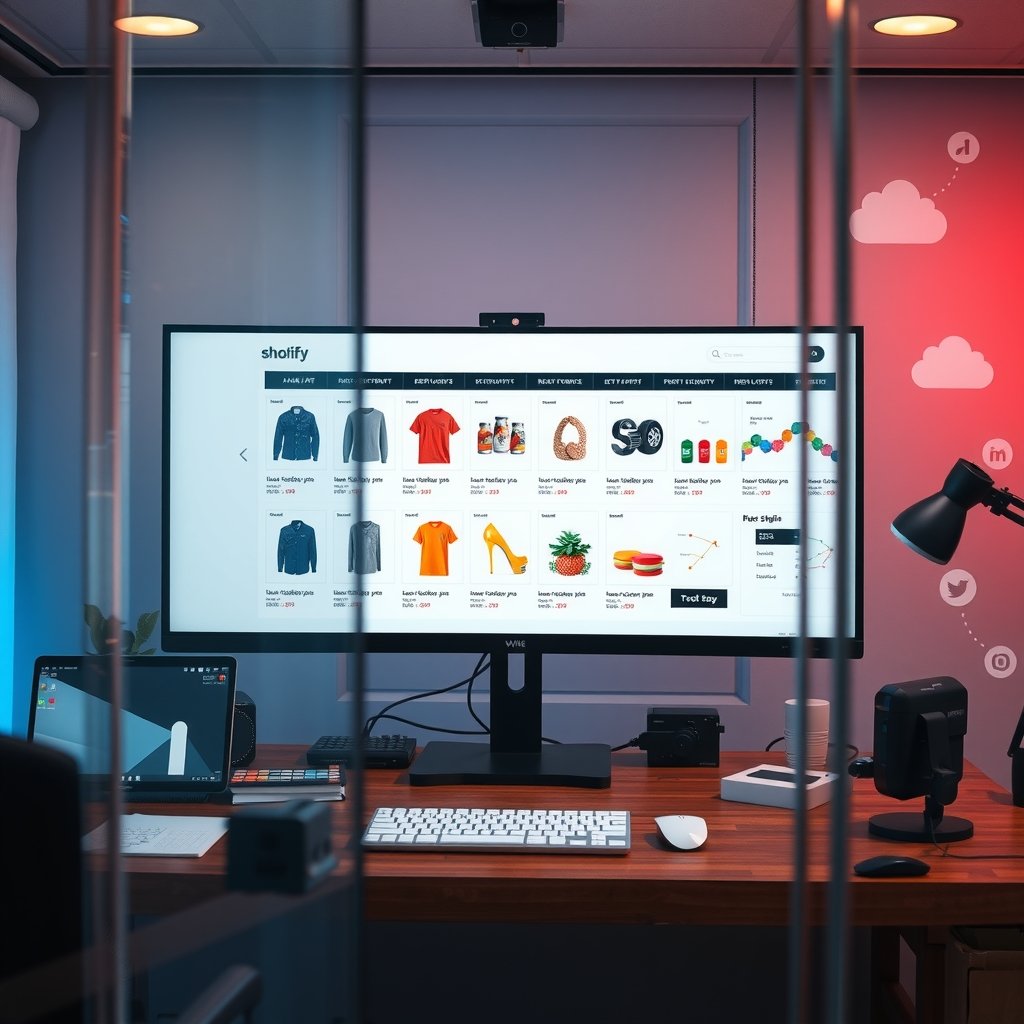
Indian ecommerce teams are entering 2026 with a difficult mix of opportunity and pressure. Customer acquisition costs are rising in Noida, Delhi NCR, Gurugram, Mumbai, Bengaluru, and Jaipur, while buyers expect fast pages, UPI-first checkout, same-day delivery visibility, WhatsApp support, and smooth mobile shopping. Many Noida brands still operate on slow custom websites, outdated WooCommerce builds, or marketplace-only sales that reduce margin control. A shopify ecommerce website solves a major part of this challenge by giving brands a stable commerce foundation, secure checkout, scalable catalog management, integrated payments, and faster launch cycles without maintaining heavy infrastructure.
📋 Table of Contents
For Noida-based D2C founders, manufacturers, fashion labels, electronics sellers, food brands, home decor companies, and B2B distributors, the real question is not whether ecommerce is needed. The question is how to build an online store that performs reliably when campaigns run, inventory changes daily, and customers compare your experience with Amazon, Nykaa, Myntra, Blinkit, and Tata Cliq. A professional Shopify ecommerce website agency helps convert business requirements into a practical storefront, covering theme design, product structure, payment setup, shipping logic, SEO services, analytics, automation, and ongoing support.
This first half explains what a Shopify ecommerce website means for Noida brands in 2026, how implementation should be planned, which tools and versions are commonly used, what decisions affect cost, and which best practices separate a basic store from a serious revenue channel. You will also see real Indian examples, INR-based planning numbers, process steps, technical snippets, and a comparison table to evaluate Shopify against common alternatives.
Understanding shopify ecommerce website
What a Shopify ecommerce website means for Noida brands
A Shopify ecommerce website is a hosted online store built on Shopify’s commerce platform, where the brand can manage products, collections, payments, checkout, discounts, inventory, customer data, orders, shipping, and analytics from one admin panel. For a Noida fashion label selling kurtas, co-ord sets, and festive wear across Delhi, Lucknow, Chandigarh, Pune, and Hyderabad, Shopify can support product variants by size, color, fabric, price, SKU, and stock count. For an electronics accessories brand in Sector 63, Noida, it can manage phone covers, chargers, earphones, warranties, GST-inclusive pricing, and COD rules without a custom backend team.
The value of Shopify is strongest when the business needs speed, reliability, and operational control. A small brand with ₹5 lakh monthly revenue may start with a clean Shopify theme and basic apps. A larger Noida D2C company doing ₹50 lakh to ₹2 crore monthly online sales may need Shopify Plus, custom integrations, advanced analytics, warehouse workflows, customer segmentation, and performance-focused design. The platform fits both stages when implemented correctly.
- Fashion example: A Noida apparel brand can create collections for “Office Wear under ₹1,999”, “Wedding Guest Dresses”, and “Winter Jackets for Delhi NCR” with filters for size, color, and price.
- Food example: A packaged snacks company in Noida can sell ₹299 trial boxes, ₹799 family packs, and ₹1,499 monthly subscriptions while showing FSSAI details and delivery restrictions.
- Home decor example: A furniture and decor seller can display products by room, material, finish, delivery city, and installation requirement for Noida, Gurugram, Ghaziabad, Faridabad, and Bengaluru.
- B2B example: A corporate gifting supplier can use Shopify with quote forms, bulk pricing, GST fields, and customer-specific catalogs for HR teams and procurement departments.
The common mistake is treating Shopify as only a website builder. It is a commerce operating system. The front-end theme is just one layer. The real success comes from catalog planning, conversion-focused UX, payment setup, automated order flows, SEO structure, customer support tools, and campaign readiness.
Why agencies matter in 2026
In 2026, a Shopify ecommerce website agency is expected to do more than install a theme. Noida brands need practical consulting because online sales are connected to logistics, finance, marketing, compliance, and customer experience. If a store looks good but loads slowly on 4G in Meerut or fails UPI payment during a Meta Ads campaign, the design has not solved the business problem. If product pages do not answer size, return, warranty, delivery, and trust questions, paid traffic will leak revenue.
A capable agency studies the brand’s product margins, AOV, repeat purchase cycle, target cities, payment preferences, catalog complexity, and marketing channels before building. For example, a beauty brand may require product bundles, reviews, skin-type filters, and WhatsApp expert consultation. A footwear brand may need size charts, exchange workflows, COD risk controls, and return automation. A B2B industrial tools seller may need RFQ forms, GST invoices, tiered pricing, and bulk order enquiry flows.
- Budget planning: A basic Shopify build in Noida may start around ₹75,000 to ₹1,50,000, while a custom D2C store can range from ₹2,50,000 to ₹8,00,000 depending on integrations.
- Timeline planning: A lean launch can take 3 to 5 weeks, while a custom theme with ERP, CRM, analytics, and migration can take 8 to 14 weeks.
- Tool planning: Common tools include Shopify CLI 3.x, Shopify Theme Check 1.x, Node.js 20 LTS, Git 2.x, Google Analytics 4, Google Tag Manager, Razorpay, Shiprocket, Zoho Inventory, and Meta Pixel.
- Operational planning: Agencies define who updates products, who handles failed payments, who reviews abandoned carts, and who monitors campaign landing pages.
For Noida brands, the agency’s local business understanding also matters. Selling to Delhi NCR customers often means COD support, quick delivery expectations, Hindi-English communication, festive campaign spikes, and heavy mobile browsing. A reliable agency aligns Shopify implementation with these realities instead of copying a generic international template.
Implementation Guide
Planning, store architecture, and technical setup
A strong Shopify ecommerce website starts with structured planning. Before choosing colors or homepage banners, the agency should define the product model, navigation, integrations, content requirements, and launch priorities. A Noida brand selling 300 SKUs does not need the same build approach as a brand selling 12 premium products. Catalog size, order volume, delivery coverage, and marketing plan should decide the implementation path.
- Audit business requirements: Document product categories, SKUs, variants, GST treatment, shipping zones, payment methods, customer support channels, and expected monthly traffic. For example, a Noida skincare brand expecting 30,000 monthly visitors from Instagram campaigns needs better speed planning than a boutique catalog site with 2,000 monthly visitors.
- Select Shopify plan and theme direction: Choose between a premium theme, customized theme, or custom section-based design. A premium theme setup may cost ₹75,000 to ₹2,00,000, while a custom storefront experience can move toward ₹4,00,000 to ₹10,00,000.
- Prepare catalog structure: Create product types, collections, tags, metafields, variant options, and naming rules. For Indian users, clear labels such as “Fabric”, “Fit”, “Warranty”, “Delivery Time”, “Return Eligible”, and “GST Invoice Available” improve decision-making.
- Configure core tools: Use Shopify CLI 3.x for theme development, Node.js 20 LTS for local tooling, Git 2.x for version control, Shopify Theme Check 1.x for quality checks, and Google Tag Manager for tracking deployment.
- Set up payments and logistics: Configure Razorpay, Cashfree, PayU, Shopify Payments where available, COD rules, Shiprocket, Delhivery, Blue Dart, or NimbusPost based on pin code coverage and pricing.
For technical teams, a simple Liquid example can control how trust information appears on product pages. Example: <p><strong>Delivery:</strong> Ships in {{ product.metafields.custom.dispatch_time }} for Noida, Delhi, Gurugram and other metro cities.</p>. This snippet uses Shopify metafields so the operations team can update dispatch information without editing theme code.
Another practical example is showing GST invoice availability only when a metafield is enabled. Example: {% if product.metafields.custom.gst_invoice == true %}<p>GST invoice available for business purchases.</p>{% endif %}. For B2B and high-value categories such as office furniture, electronics, industrial tools, and corporate gifting, this small detail can improve enquiry quality.
Build, migration, testing, and launch process
Once planning is complete, implementation should move in controlled phases. Rushing directly into visual design often creates rework because product data, tracking, shipping, and checkout rules are discovered too late. A disciplined Shopify ecommerce website agency creates a staging environment, tests real business scenarios, and launches only after operational teams are ready.
- Design page templates: Build homepage, collection page, product page, cart, search, blog, policy pages, account pages, and campaign landing pages. For a Noida ethnic wear brand, product pages should show size guide, fabric care, delivery estimate, return window, and WhatsApp support.
- Migrate content and products: Import products through Shopify CSV, Matrixify, or custom scripts. Clean product titles, alt text, image names, URLs, and metafields before upload. Migration cost may range from ₹25,000 for a small catalog to ₹2,00,000+ for complex data cleanup.
- Install and configure essential apps: Use Judge.me for reviews, Klaviyo or Mailchimp for email, WebEngage or MoEngage for retention, Shiprocket for shipping, Razorpay for payments, ReConvert for post-purchase offers, and Searchanise or Shopify Search & Discovery for search.
- Implement analytics: Configure Google Analytics 4, Google Tag Manager, Meta Pixel, Google Ads conversion tracking, Microsoft Clarity, and server-side tracking where campaign spend justifies it. A brand spending ₹3 lakh per month on ads cannot rely on broken purchase events.
- Test real user journeys: Test UPI, cards, net banking, COD, discount codes, cart notes, mobile checkout, order emails, refund flow, delivery zones, abandoned carts, and out-of-stock states across Chrome, Safari, Android, and iPhone.
- Launch with monitoring: Freeze major theme changes before launch, update DNS, verify payment capture, test first live order, check tracking events, and monitor errors for 48 to 72 hours.
For Noida brands moving from WooCommerce, Magento, or a custom PHP site, the migration stage must protect SEO URLs and customer trust. Redirect old product and category URLs, preserve high-performing content, migrate reviews when possible, and avoid changing product naming without reason. A badly planned migration can reduce organic traffic from Delhi, Mumbai, Bengaluru, Chennai, Pune, and Ahmedabad searches even if the new store looks better.
After working with 50+ Indian SMEs on shopify ecommerce website implementations, companies investing ₹3-5 lakhs upfront save ₹15-20 lakhs over 12 months. Choose the right tech stack from day one - reactive decisions cost 3-5x more.
Best Practices for shopify ecommerce website
Conversion, speed, and mobile-first decisions
A Shopify ecommerce website succeeds when it helps customers decide quickly and buy without friction. Indian shoppers often browse on mobile data, compare prices across marketplaces, ask questions on WhatsApp, and expect clarity before paying. The store should answer objections before they become exits. Every design choice should support trust, speed, product understanding, and checkout completion.
- Do prioritize mobile performance: Keep homepage sections lean, compress images with tools such as TinyPNG or Shopify’s built-in image CDN, avoid unnecessary sliders, and test on budget Android devices used across Noida, Ghaziabad, Kanpur, Patna, Indore, and Jaipur.
- Do show clear pricing: Display MRP, selling price, discount percentage, GST information where relevant, and delivery charges before checkout. If a product is ₹1,299 plus ₹79 shipping, do not hide the shipping cost until the last step.
- Do build product pages for decision-making: Include size charts, comparison points, care instructions, ingredients, warranty, returns, delivery estimate, customer reviews, and real product photos.
- Do use trust signals: Add COD availability, secure payment messaging, exchange policy, warranty, GST invoice availability, customer support hours, and delivery partners such as Delhivery, Blue Dart, DTDC, or Shiprocket.
- Do prepare campaign landing pages: For Meta Ads, Google Shopping, influencer campaigns, and WhatsApp broadcasts, build focused pages instead of sending all traffic to the homepage.
The most common mistake is overloading the store with apps. Every app can add scripts, slow down pages, affect checkout behavior, or create tracking conflicts. A Noida brand may install review widgets, spin wheels, popups, loyalty apps, chat tools, recommendation tools, WhatsApp buttons, and analytics scripts in the first month. This usually reduces speed and makes debugging harder. The better approach is to start with essential apps, measure performance, and add only what improves revenue or operations.
- Do not copy marketplace layouts blindly: Your brand store needs clarity, story, and trust, not just endless product grids.
- Do not use oversized banners: A 3 MB mobile banner can hurt Core Web Vitals and reduce conversions from paid traffic.
- Do not hide policies: Return, refund, shipping, cancellation, and privacy pages must be easy to find.
- Do not ignore search: If the store has more than 100 SKUs, search and filters become revenue tools, not minor features.
- Do not launch without failed payment handling: UPI failures, pending payments, and abandoned checkouts need automated follow-up through email, SMS, or WhatsApp.
Operations, SEO, analytics, and long-term growth
After launch, the Shopify ecommerce website becomes a daily business system. The agency and internal team should define responsibilities for product updates, homepage changes, discount rules, inventory sync, order review, returns, customer support, and campaign reporting. Without ownership, even a well-built store becomes outdated within months.
- Do maintain clean product data: Use consistent product titles, SKUs, variant names, image ratios, descriptions, and metafields. A footwear store should not mix “UK 8”, “8 UK”, and “Size-8” across products.
- Do optimize SEO basics: Write unique title tags, meta descriptions, collection copy, image alt text, and clean URLs. A collection URL like /collections/noida-office-wear is clearer than a random imported category path.
- Do track the full funnel: Review sessions, add-to-cart rate, checkout reached, payment success rate, conversion rate, AOV, repeat purchase rate, refund rate, and COD RTO percentage.
- Do segment customers: Separate first-time buyers, repeat customers, high-value buyers, COD customers, abandoned checkout users, and city-based audiences such as Delhi NCR, Mumbai, Pune, Bengaluru, and Hyderabad.
- Do review monthly costs: Shopify plan fees, apps, payment gateway charges, shipping, agency retainers, email tools, and analytics tools should be compared against revenue impact.
The operational cost of a Shopify store is predictable when planned. A growing Noida D2C brand may spend ₹2,000 to ₹8,000 per month on Shopify plan fees, ₹5,000 to ₹40,000 per month on apps, ₹20,000 to ₹1,50,000 per month on agency support, and separate costs for ads, shipping, payment gateway charges, and content creation. The right agency helps control this stack instead of adding tools for every small request.
- Do not publish duplicate product descriptions: Reused supplier content weakens search visibility and brand trust.
- Do not run discounts without margin checks: A 25% discount plus free shipping plus COD RTO can turn a profitable campaign into a loss.
- Do not ignore analytics discrepancies: If Shopify, GA4, Razorpay, and Meta Ads report very different numbers, fix tracking before scaling ad spend.
- Do not depend on one traffic channel: Balance SEO, Google Shopping, Meta Ads, WhatsApp retention, email, influencers, and marketplace retargeting.
- Do not treat maintenance as optional: Theme updates, app audits, speed checks, broken link reviews, and conversion audits should be scheduled monthly or quarterly.
For 2026, the best Shopify ecommerce website strategy for Noida brands is practical and measurable. Build a fast storefront, make the catalog easy to understand, integrate reliable Indian payment and delivery tools, track every revenue event, and keep improving based on data. The agency’s role is to connect design, technology, operations, and growth into one working system.
Comparison Table
| Platform or Approach | Typical 2026 Cost in India | Best Fit for Noida Brands |
|---|---|---|
| Shopify standard build | ₹75,000 to ₹2,50,000 setup; ₹2,000 to ₹8,000 monthly platform cost | Brands with 20 to 500 SKUs needing quick launch, stable checkout, Razorpay, Shiprocket, GA4, and mobile-first design |
| Custom Shopify theme | ₹3,00,000 to ₹10,00,000 setup; ₹25,000 to ₹1,50,000 monthly support | D2C brands doing ₹10 lakh to ₹2 crore monthly revenue and requiring custom UX, metafields, landing pages, and advanced tracking |
| WooCommerce website | ₹60,000 to ₹4,00,000 setup; hosting from ₹1,500 to ₹25,000 monthly | Content-heavy businesses that want WordPress control but can manage hosting, plugin conflicts, security, and developer support |
| Magento or Adobe Commerce | ₹12,00,000 to ₹75,00,000+ setup; high maintenance and server cost | Large enterprises with complex catalogs, multi-store workflows, custom ERP logic, and dedicated technical teams |
| Marketplace-only selling | Low website setup cost; commissions often 8% to 35% per sale | Useful for discovery on Amazon, Flipkart, Myntra, or Nykaa, but weak for brand control, customer ownership, and long-term margins |
Many Indian businesses skip proper testing in shopify ecommerce website projects to save 2-3 weeks, leading to production bugs costing ₹2-5 lakhs in lost revenue. Always allocate 25% of budget for QA.
Advanced Techniques for Shopify Ecommerce Website Growth
For Noida brands competing in crowded categories, a shopify ecommerce website must do more than display products. It should function as a measurable revenue system that connects product discovery, merchandising, customer service, payments, fulfilment, retention and analytics. Advanced implementation is especially important when a store is moving beyond its first few hundred orders and beginning to serve customers across Delhi NCR, Bengaluru, Mumbai, Hyderabad and other Indian cities. At this stage, small improvements in speed, conversion rate and average order value can create substantial revenue without proportionately increasing advertising expenditure.
Scaling Strategies for Noida Brands
The first scaling strategy is to separate growth into controlled operating layers. Begin with a dependable product and catalogue structure. Use consistent product titles, attribute names, variant conventions, image ratios and collection rules. This makes it easier to expand from 100 products to 1,000 products without creating duplicate collections or confusing customers. A Shopify ecommerce website agency should also design collection templates that support seasonal launches, regional demand, bestseller sorting, stock availability and promotional campaigns.
Brands should then create a repeatable landing-page system. Instead of building every campaign page from scratch, develop reusable layouts for search campaigns, influencer traffic, festive promotions, city-specific offers and high-margin categories. For example, a Noida fashion brand may need dedicated pages for workwear, wedding clothing, monsoon essentials and premium accessories. Reusable sections reduce development time and allow the marketing team to launch new campaigns within hours rather than weeks.
Scaling also requires operational readiness. Set inventory alerts before bestsellers reach zero stock, synchronise the store with warehouse processes and define clear rules for partial fulfilment, exchanges and cash-on-delivery verification. Indian customers often compare delivery estimates before purchasing, so showing accurate delivery information for Noida, Ghaziabad, Gurugram and nearby pin codes can reduce checkout abandonment. As order volume increases, segment customers by purchase frequency, product category, city, margin and return behaviour. These segments can support more relevant email, WhatsApp and remarketing campaigns.
For international or multi-region expansion, keep tax, currency, shipping and catalogue logic modular. A store that begins in India may later serve customers in Dubai, Singapore or the United Kingdom. Building clean product data and flexible shipping rules early prevents expensive rework. Experts should also document ownership for theme updates, app configuration, analytics, inventory and content so the store does not become dependent on one developer.
Performance Optimization and Expert-Level Improvements
Performance optimization begins with reducing unnecessary code and visual weight. Compress product images without damaging their quality, use modern image formats where supported, remove unused applications and avoid installing multiple apps that perform similar functions. Every app can add scripts, requests or tracking elements, and the combined impact may slow mobile browsing. Since a significant portion of Indian ecommerce traffic comes from mobile devices and variable network conditions, performance should be tested on realistic 4G connections rather than only on a high-speed office network.
Improve the first visible screen by prioritising the logo, navigation, value proposition, primary product image and key buying action. Delay non-essential reviews, recommendation widgets and secondary animations until after the main content is available. Keep promotional banners focused: a single clear offer generally performs better than multiple rotating banners competing for attention. Product pages should load the main image quickly, show price and delivery information immediately, and make size, quantity, payment and return details easy to understand.
Advanced teams should monitor performance by template, device, traffic source and geography. A store may appear fast on desktop but be slow on Android devices from a paid social campaign. Use analytics events to identify where visitors drop: product view, variant selection, add to cart, checkout start or payment completion. Run controlled experiments on headlines, bundles, trust badges, free-shipping thresholds and checkout messaging. Do not judge tests only by clicks; measure contribution margin, refund rate and repeat purchases.
Experts can also improve revenue through intelligent merchandising. Promote high-margin complementary products, create bundles that solve a complete customer need and use stock-aware recommendations. Test free shipping against a fixed shipping charge, but account for the cost of reverse logistics and cash-on-delivery returns. Finally, maintain a performance budget for page weight, app scripts and tracking calls. A technically attractive feature is not valuable if it reduces conversion or makes the store difficult to maintain.
Real World Case Study: Bangalore Brand Transformation
A Bangalore-based direct-to-consumer company selling premium home organisation products approached a Shopify ecommerce website agency after experiencing stagnant growth. The company had a functioning online store, but the website had been assembled through several theme edits and disconnected applications. Its primary customers were in Bengaluru, Chennai, Hyderabad, Mumbai and Delhi NCR, while the fulfilment centre was located on the outskirts of Bengaluru.
The business had generated monthly traffic of approximately 62,000 sessions, but only 1.18% of visitors completed a purchase. The average order value was INR 2,140, and the monthly advertising budget was INR 9.5 lakh. Of the 1,126 monthly orders, 19% were cancelled or returned, partly because delivery estimates were unclear and product dimensions were difficult to understand. The company also received only 74 qualified leads per month for its bulk office-storage enquiry programme. Its paid campaigns produced a blended return on ad spend of 1.4x, which was below the management target of 2.2x.
Week 1-2: Discovery and Commercial Diagnosis
During the first two weeks, the team audited analytics, heatmaps, product data, ad landing pages, checkout behaviour, app scripts, mobile layouts and customer-support conversations. The audit showed that 41% of mobile visitors left before the product page finished loading. Another 28% of add-to-cart users abandoned before starting checkout. Customers frequently asked support teams about product size, delivery dates, installation requirements and return eligibility, even though these details could have been displayed more clearly on the product pages.
The team interviewed the founders, fulfilment manager, customer-service representatives and paid media agency. Products were grouped into entry-level organisers, premium modular systems and bulk office solutions. The discovery phase identified 23 products with strong margins but weak visibility, 11 products with high return rates and 16 landing pages with inconsistent messaging. A revised measurement framework was created for revenue, qualified leads, conversion rate, average order value, return rate, fulfilment time and advertising efficiency.
Week 3-4: Implementation of the Shopify Ecommerce Website
In weeks three and four, the agency rebuilt the core theme structure with a mobile-first approach. Product templates were redesigned to show dimensions, material, capacity, delivery estimates, return terms and frequently purchased combinations near the buying action. The team compressed 386 product and banner images, removed seven redundant app scripts and consolidated reviews, recommendations and pop-up functionality into fewer systems.
New collections were created for apartment storage, work-from-home setups, office procurement and small-space kitchens. A guided bundle selector helped customers choose combinations based on room type and storage need. For bulk buyers, the team added a structured enquiry form that captured company size, product category, expected quantity, city and preferred contact time. Delivery messaging was connected to pin-code logic, allowing shoppers in Bengaluru, Noida and other major cities to see more realistic estimates.
The checkout experience was simplified by clarifying payment options, return conditions and cash-on-delivery verification. Email and WhatsApp flows were created for abandoned carts, viewed products, post-purchase education and replenishment reminders. All important actions were mapped to analytics events so that campaign performance could be evaluated beyond last-click revenue.
Week 5-6: Optimization and Controlled Testing
During weeks five and six, traffic was divided across revised landing pages and selected control pages. The team tested product photography with a room context against isolated product images, compared a percentage discount with a bundle benefit, and tested a free-shipping threshold of INR 1,999 against the existing flat shipping message. They also tested a shorter enquiry form against the original eight-field form.
The room-context photography improved product engagement because customers could better understand scale. The bundle offer increased average order value without reducing gross margin as heavily as the percentage discount. The shorter form increased completed bulk enquiries, while an automatic follow-up process helped the sales team prioritise high-volume opportunities. Ads were restructured around profitable categories and creative messages that matched the revised landing pages.
Week 7-8: Results and Business Impact
By weeks seven and eight, the store recorded a 47% improvement in conversion performance compared with the baseline period. Monthly qualified leads increased to 183, giving the business a stronger pipeline for office and property-management orders. Better product information and clearer delivery expectations reduced avoidable support interactions and helped lower cancellation-related costs. The redesigned merchandising structure also increased bundle adoption and raised order value.
The company saved INR 3.2 lakh through reduced application costs, lower avoidable returns, better advertising allocation and fewer manual sales follow-ups. Blended advertising efficiency reached 2.7x ROAS. The result was not produced by one visual redesign alone; it came from aligning technology, content, operations, analytics and commercial decision-making. The business continued using the same framework for new product launches and city-specific campaigns.
| Metric | Before | After | Change |
|---|---|---|---|
| Monthly sessions | 62,000 | 68,400 | 10.3% increase |
| Conversion rate | 1.18% | 1.73% | 47% improvement |
| Average order value | INR 2,140 | INR 2,590 | 21% increase |
| Monthly orders | 1,126 | 1,578 | 40.1% increase |
| Qualified bulk leads | 74 | 183 | 147% increase |
| Blended ROAS | 1.4x | 2.7x | 1.3x improvement |
| Cancellation and return rate | 19% | 13.6% | 5.4 percentage-point reduction |
Common Mistakes to Avoid
1. Choosing a Theme Without Considering Conversion Goals
Some brands select a theme because it looks attractive in a demonstration store. They later discover that the theme does not support their product options, bundles, filters or mobile buying flow. Replacing a poorly selected theme can cost INR 1.5 lakh to INR 4 lakh in design, development, migration and testing. Avoid this mistake by documenting product complexity, collection requirements, content needs and checkout expectations before selecting a theme. A Shopify ecommerce website agency should test the theme with real products, not placeholder content.
2. Installing Too Many Apps
Adding an app for every requirement can create overlapping features, slow page speed and increase monthly operating expenses. A store may spend INR 25,000 to INR 80,000 each month on applications that are rarely used, while also losing sales because extra scripts delay mobile page loading. Audit apps quarterly, remove duplicates and confirm whether the existing theme or Shopify functionality can solve the need. Keep only applications that produce measurable revenue, operational savings, compliance value or meaningful customer support benefits.
3. Ignoring Product Information and Delivery Clarity
Customers cannot confidently purchase when product dimensions, materials, compatibility, delivery dates or return rules are hidden. The direct cost may include INR 50,000 to INR 2 lakh per month in avoidable returns, support tickets, re-shipping and cancelled orders for a growing brand. Prevent this by creating a product-content checklist and displaying decision-making information near the purchase button. Use clear images, comparison tables, measurement diagrams and pin-code-based delivery estimates. Review support conversations every month to identify information gaps.
4. Measuring Traffic Instead of Profit
High traffic can create a false impression of growth when campaigns attract visitors who do not purchase or who generate low-margin orders. Misallocated advertising can waste INR 1 lakh to INR 10 lakh per month depending on the brand’s budget. Track contribution margin, new versus returning customer revenue, refund rate, shipping cost, payment fees and customer acquisition cost alongside revenue. Create channel-level dashboards and pause campaigns that do not meet agreed profitability thresholds after a statistically reasonable testing period.
5. Treating Mobile Experience as a Smaller Desktop Version
Indian customers frequently browse and purchase from mobile devices, yet many stores hide essential information below large banners or use difficult navigation menus. A weak mobile experience can reduce revenue by INR 2 lakh to INR 15 lakh per month for a mid-sized brand, depending on traffic volume and average order value. Avoid this by designing mobile layouts first, testing on multiple Android devices, keeping buttons thumb-friendly and reducing unnecessary pop-ups. Review the complete journey from advertisement to product page, cart and payment confirmation on realistic mobile networks.
Frequently Asked Questions
What should a shopify ecommerce website include for a Noida brand?
A shopify ecommerce website for a Noida brand should include a fast mobile-first storefront, clear product information, reliable payment options, accurate delivery estimates and a simple returns process. The structure should support local customer expectations while remaining ready for orders from Gurugram, Ghaziabad, Delhi, Bengaluru, Mumbai and other cities. Important elements include searchable collections, useful filters, high-quality product images, size or dimension guidance, customer reviews, secure checkout and visible contact options. Brands should also connect analytics, inventory, shipping and customer-support workflows so that commercial decisions are based on complete data. If the brand sells to businesses, the website should include a qualified enquiry form, bulk pricing logic or a sales-assistance process. The right implementation balances visual identity with speed, usability, operational accuracy and measurable conversion goals.
How long does it take to build or redesign a Shopify store?
The timeline depends on catalogue size, integrations, content readiness, theme requirements and the complexity of the checkout or fulfilment process. A focused redesign for an established store may take four to eight weeks, while a new store with custom sections, product migration, ERP integration, subscription functionality or a business-to-business workflow may require eight to fourteen weeks. Discovery and content preparation often determine the real schedule. If product descriptions, images, pricing and policies are incomplete, development may finish before the store is commercially ready. A professional process normally includes discovery, information architecture, design, development, data migration, integration, quality assurance, analytics configuration and launch support. It is safer to plan a controlled release with tested priority journeys than to rush every feature into the first launch.
How much does a Shopify ecommerce website cost in India?
Cost varies according to design depth, custom development, number of products, integrations and post-launch support. A basic professionally configured store may cost between INR 75,000 and INR 2 lakh, while a customised growth-focused implementation can range from INR 2.5 lakh to INR 8 lakh or more. Enterprise requirements, complex catalogues, ERP connections, custom applications and advanced automation can increase the investment further. The project budget should also account for Shopify subscription charges, premium theme licensing, application fees, payment gateway charges, photography, copywriting, shipping tools and ongoing optimisation. The lowest initial quote may not be the lowest total cost if the store requires repeated redevelopment or produces expensive conversion problems. Ask for a scope that clearly identifies deliverables, integrations, testing, training and support responsibilities.
Can an existing Shopify store be improved without rebuilding everything?
Yes, many stores can achieve substantial improvement through a structured audit and selective redevelopment. An agency can review the theme, templates, scripts, navigation, product data, checkout messaging, analytics and applications before deciding what should remain. If the underlying theme is stable, it may be possible to redesign key templates, improve speed, replace weak sections and correct tracking without a complete rebuild. However, a full rebuild may be more efficient when the store contains heavily modified legacy code, conflicting applications, poor product structures or unreliable integrations. The decision should be based on technical debt, expected revenue impact, maintenance difficulty and migration risk. A staged approach is often practical: repair high-impact conversion problems first, then replace deeper structural components during a planned release.
How can a Shopify agency improve conversion rates?
Conversion improvement begins by finding the exact points where customers hesitate or leave. The agency should combine analytics, session recordings, heatmaps, customer-service questions, user interviews and campaign data. Common improvements include faster mobile loading, clearer product benefits, better images, transparent delivery information, improved filters, stronger trust signals, fewer checkout distractions and more relevant bundles. The team should test changes rather than relying only on personal preference. It is also important to measure quality of revenue. A conversion increase that comes from heavy discounting may reduce profit or attract customers who return products frequently. Effective optimisation considers conversion rate, average order value, gross margin, refund rate, customer acquisition cost and repeat purchase behaviour. The best agencies create a prioritised testing roadmap tied to commercial targets.
What ongoing support does a growing Shopify brand need?
Growing brands need ongoing support because products, campaigns, customer expectations and platform requirements continuously change. Monthly support may include theme maintenance, new landing pages, product merchandising, analytics review, speed monitoring, application audits, campaign implementation and troubleshooting. Brands should also review their search and collection structure when adding products, test promotional campaigns before launch and check that tracking remains accurate after theme or application updates. Operational support can cover inventory alerts, shipping rules, payment issues and return workflows. A useful support arrangement includes response-time expectations, a prioritised backlog and regular performance reporting. The agency should explain completed work in commercial terms, such as faster load time, improved lead quality, reduced support workload or higher revenue per visitor. This keeps the partnership focused on business outcomes rather than random website changes.
🚀 Ready to Implement This?
Get expert help from ShivatechDigital. 200+ Indian businesses already grew with our technology solutions.
Book Free Consultation →⚡ Response within 24 hours | 🇮🇳 Trusted by Indian businesses
Conclusion
A shopify ecommerce website can become a powerful growth engine for Noida brands when it is designed around customers, operations, performance and measurable profitability. The strongest results come from combining a clear catalogue, fast mobile experience, trustworthy product information, relevant merchandising and disciplined optimisation. The Bangalore case study demonstrates that meaningful gains do not depend only on increasing advertising spend; they can come from removing friction across the complete buying journey.
Brands should treat the store as an evolving commercial system rather than a one-time design project. Every new campaign, product category and customer segment should strengthen the same foundation of speed, clarity and data quality.
- Audit your current store across mobile performance, product-page clarity, checkout abandonment, applications, returns and analytics accuracy.
- Prioritise the three changes most likely to improve profitable revenue, such as better landing pages, clearer delivery information or high-margin bundles.
- Create a 90-day optimisation roadmap with defined owners, testing dates and targets for conversion rate, average order value, qualified leads and ROAS.
10+ years experience helping 200+ businesses across Delhi, Noida, Greater Noida, Ghaziabad and Kanpur grow through technology. Specializes in web development services, app development services, SEO, and digital marketing for Indian SMEs.







0
No comments yet. Be the first to comment!