
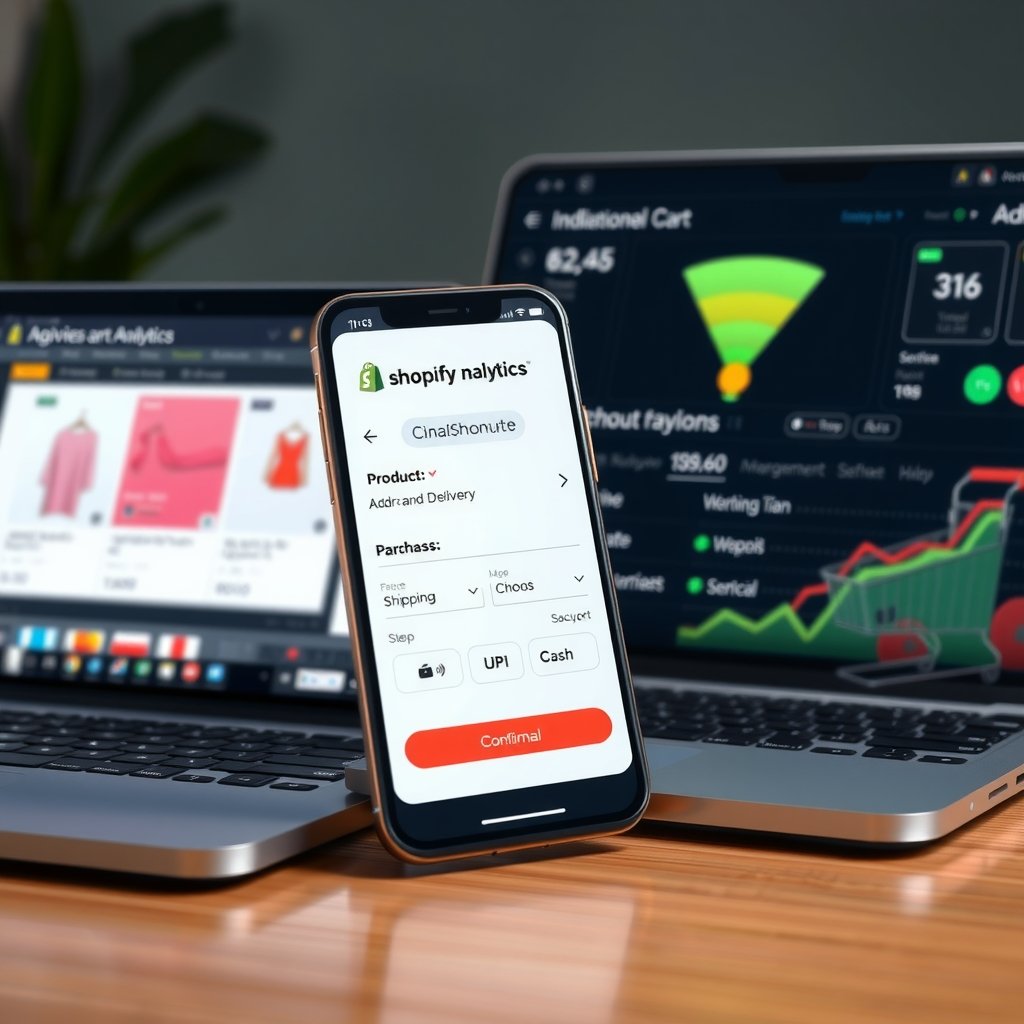
A customer in Noida adds a ₹1,499 skincare kit to her cart during a lunch break. She reaches checkout, discovers a delivery charge she did not expect, switches to a UPI app, and returns to a payment screen that appears stuck. Another customer in Lucknow chooses cash on delivery because the prepaid journey feels unreliable. The advertising dashboard records traffic, but the business pays for sessions that never become dependable orders. This is where shopify development needs to move beyond attractive themes and focus on the practical details of buying, paying, and receiving an order in India.
📋 Table of Contents
For a D2C brand operating from Noida, checkout performance connects marketing, engineering, finance, and fulfilment. A faster storefront cannot compensate for incorrect shipping eligibility. A discount campaign cannot fix a confusing payment failure. A successful payment does not guarantee profitable revenue if the resulting order later becomes a return-to-origin shipment. The checkout journey must support the entire commercial transaction, not just the final button.
This first-half playbook explains how to approach Shopify checkout development in 2026 without confusing theme customisation, payment integration, and platform-controlled checkout capabilities. You will learn how to define a realistic scope, select supported tools, implement a controlled release process, and evaluate payment costs using transparent INR calculations.
The examples use Indian buying scenarios and real tools, including Razorpay, Shopify CLI, Google Analytics 4, and Shopify Checkout Extensibility. The objective is straightforward: build a checkout journey that customers understand, developers can maintain, and an operations team can trust when daily orders increase.
Understanding shopify development
Storefront development and checkout development are different jobs
Shopify development covers several connected layers: the storefront customers browse, the cart where purchase decisions become explicit, the checkout where Shopify coordinates order information and payment, and the integrations that support fulfilment. Treating these as one unrestricted codebase creates unrealistic promises. A developer can change a theme extensively, but cannot assume that the same freedom exists inside every checkout screen.
For many Noida D2C businesses, the right starting point is an Online Store 2.0 theme with carefully selected applications. Liquid templates, theme sections, CSS, and JavaScript support changes to product pages and carts. Shopify's supported checkout features then handle the transaction. Where eligible, Checkout Extensibility provides structured customisation through extensions and related platform capabilities rather than arbitrary scripts injected into checkout.
Plan eligibility matters. Checkout UI extensions on the information, shipping, and payment steps are a Shopify Plus capability. Other extension surfaces have their own availability rules. Shopify Functions also require attention to app distribution and plan restrictions: a function delivered through a public app is not equivalent to one delivered through a custom app. Confirm the exact feature and deployment route before including it in a proposal.
- Theme work: Product-page clarity, cart messaging, responsive layouts, accessible controls, and visible shipping information.
- Checkout configuration: Branding settings, payment methods, shipping rates, supported checkout options, and customer-information requirements.
- Eligible extensions: Approved interface additions that use Shopify's extension framework and permitted APIs.
- Operational integrations: Payment reconciliation, inventory updates, courier allocation, refunds, and customer notifications.
Consider an illustrative apparel brand in Sector 63, Noida, selling a ₹1,899 kurta. Showing size guidance, exchange terms, and a ₹99 shipping charge before checkout may solve more customer uncertainty than an expensive visual redesign. A Bengaluru subscription brand might have a different priority: making recurring purchase terms and payment compatibility explicit. Both need development, but their requirements should not be copied from the same generic checklist.
Indian checkout economics should shape the technical scope
Checkout optimisation should improve commercially useful outcomes, not merely increase the number of orders placed. A Delhi NCR brand can increase COD orders while simultaneously increasing verification effort, courier costs, and return-to-origin exposure. Equally, forcing prepaid payment can exclude customers who have legitimate reasons to prefer COD. The engineering task is to support a clear, workable policy and measure its consequences.
Start by mapping customer expectations across serviceable locations. A parcel dispatched within Noida may have different delivery timing from one sent to Jaipur or Guwahati. Shipping estimates should reflect carrier capability, dispatch cut-offs, and actual warehouse operations. Avoid presenting a universal delivery promise simply because the theme contains a convenient text field.
- Payment confidence: Explain available payment methods accurately and distinguish pending, failed, and successful payments.
- Price transparency: Surface shipping thresholds, applicable taxes, and discount conditions before the customer commits.
- Address quality: Collect the information needed for delivery without turning the form into an unnecessary questionnaire.
- COD policy: Define eligibility, any collection charge, confirmation workflow, and the process for handling unsuccessful deliveries.
- Profitability: Evaluate payment fees, discounts, fulfilment costs, refunds, and returns alongside conversion.
For example, a ₹1,000 prepaid purchase processed at a 2% gateway fee incurs ₹20 before tax on that fee. At 18% GST on the ₹20 service charge, the gateway debit becomes ₹23.60 under those assumptions. Any applicable Shopify third-party transaction fee is separate. These distinctions belong in the project brief because a misleading cost model can produce a technically successful but commercially disappointing checkout.
Implementation Guide
Define the checkout contract and prepare a reproducible toolchain
A reliable implementation begins with a written checkout contract: what customers can buy, where orders can be delivered, which payment methods are supported, and what happens when an operation fails. For a Noida team working with a remote developer in Pune, this contract prevents business rules from being scattered across messages, theme settings, and application dashboards.
- Record the existing journey. Document product selection, cart behaviour, shipping charges, discount application, payment initiation, order creation, and confirmation. Capture differences between mobile and desktop rather than assuming the experiences match.
- Audit platform eligibility. Record the Shopify plan, installed apps, checkout configuration, and requested customisations. Mark each requirement as native configuration, theme work, an eligible extension, or an integration. Reject unsupported approaches before development begins.
- Define order rules. Agree on serviceable PIN codes, shipping thresholds, tax configuration, COD availability, inventory behaviour, cancellation handling, and refund ownership. Have finance and operations review the rules that affect their work.
- Set measurable acceptance criteria. Specify expected behaviour for successful, pending, failed, and cancelled payments. Define performance targets separately from revenue targets so neither becomes a vague promise.
- Prepare isolated environments. Use an unpublished theme for storefront changes and an appropriate development store for supported app and checkout work. Development-store behaviour is useful but does not replace checking production configuration and eligible live payment behaviour.
Use a reproducible toolchain rather than installing whatever happens to be newest on release day. A practical baseline is Node.js 22 LTS, a compatible Shopify CLI 3.x release, TypeScript 5.9 where custom application code requires it, and Git for version control. Record exact installed patch versions and commit the dependency lockfile. These are baseline choices, not a claim that every combination works without checking package engine requirements.
For custom app API calls, an explicitly tested Shopify API version 2026-07 can provide a stable project baseline during the relevant support window. Confirm that each API or extension surface supports the selected version; theme Liquid development does not require an Admin API version merely to render templates. Review supported versions and migration requirements during ongoing maintenance.
Useful commands include shopify version to record the installed CLI, shopify theme dev for theme development, shopify theme check for static theme checks, and shopify app dev for a generated application project. Use Shopify's generated project structure where applicable instead of adapting an obsolete checkout tutorial.
Implement, test, and release the complete transaction path
Implementation should follow the customer's transaction, not the order in which developers find individual tasks convenient. An attractive cart is unfinished if its discount messaging contradicts checkout. A payment integration is unfinished if support cannot identify what happened when a customer reports a debit without a visible confirmation.
- Clarify the cart. Show product variants, quantities, line prices, applied discounts, and the relevant shipping policy. If free shipping begins at ₹1,499, explain whether qualification depends on the subtotal before or after discounts. Keep the message aligned with configured rates.
- Configure payments through supported integrations. Use the approved gateway integration, such as Razorpay where available for the merchant and account configuration. Confirm merchant onboarding, enabled methods, settlement details, and refund procedures. Do not assume Shopify Payments is available merely because an international tutorial uses it.
- Implement supported customisations. Keep theme logic outside restricted checkout areas. Use eligible Checkout UI Extensions or suitable apps for requirements inside checkout. Do not copy legacy DOM-manipulation snippets into a modern extension project.
- Connect fulfilment carefully. Validate address and shipping information passed to tools such as Shiprocket. Ensure downstream processing respects payment status and the agreed COD workflow. A created order and a paid order are not interchangeable operational signals.
- Make custom event handling dependable. Where a custom backend receives webhooks, verify signatures using the provider's documented method, acknowledge valid events appropriately, and prevent duplicate processing. Retry transient downstream failures without creating another shipment or issuing another refund.
- Release with a rollback path. Publish the approved theme or extension only after acceptance checks. Keep the previous theme available, record configuration changes, and identify how each deployed component can be reverted.
Use Shopify's supported testing facilities and the gateway's documented test mode where available. Exercise a ₹999 order below the shipping threshold, a ₹1,499 threshold order, and a discounted order that crosses back below it. Test a serviceable Noida address, another serviceable city, and a PIN code outside the agreed delivery area.
Payment checks should include a successful attempt, an abandoned attempt, a pending status, and a failed attempt. Where feasible, test returning from a payment app and refreshing the confirmation page. A test transaction does not fully reproduce every live UPI app or bank response, so a small authorised production transaction may be necessary after launch, with its refund and reconciliation recorded.
Finally, validate measurement. Google Analytics 4 events such as begin_checkout, add_shipping_info, add_payment_info, and purchase should be implemented through supported integrations or customer-event mechanisms. Confirm event availability, consent behaviour, and duplicate prevention instead of assuming every event fires identically across all checkout configurations.
After working with 50+ Indian SMEs on shopify development implementations, companies investing ₹3-5 lakhs upfront save ₹15-20 lakhs over 12 months. Choose the right tech stack from day one - reactive decisions cost 3-5x more.
Best Practices for shopify development
Do reduce uncertainty, improve mobile usability, and respect platform boundaries
The strongest checkout improvements often remove ambiguity rather than add features. Indian shoppers may move between a browser, a UPI app, messaging notifications, and an unreliable mobile connection during a single purchase. Good shopify development anticipates interruptions while avoiding unsupported changes to payment-provider or Shopify-controlled interfaces.
- Do explain the final price early. State delivery charges, free-shipping eligibility, and any permitted COD charge clearly. If a customer in Ghaziabad sees ₹1,299 on the product page and ₹1,448 at checkout, each additional amount should have an understandable reason. Avoid misleading promotional prices that conceal unavoidable charges.
- Do prioritise mobile interactions. Use readable text, visible focus states, suitable input types, and adequately sized controls in the parts of the journey you control. Check variant selection and cart editing on a physical Android device as well as a desktop browser's mobile preview.
- Do use established performance thresholds. For storefront monitoring, target good Core Web Vitals: Largest Contentful Paint at or below 2.5 seconds, Interaction to Next Paint at or below 200 milliseconds, and Cumulative Layout Shift at or below 0.1. Evaluate field performance at the 75th percentile where sufficient data exists; a single Lighthouse run is not equivalent evidence.
- Do keep policy messaging consistent. Product pages, carts, checkout configuration, and support responses should agree on shipping, returns, exchanges, and payment options. A claim of free returns should not coexist with an undisclosed reverse-logistics deduction.
- Do design for payment-state clarity. Follow the gateway's supported pending-payment flow. Do not tell a customer to pay again immediately when confirmation is delayed. Support should have a documented procedure for locating the order, checking the gateway record, and resolving the discrepancy.
- Do provide proportionate trust information. Display accurate business details and relevant policies. Use genuine customer reviews rather than manufactured urgency. A clear dispatch estimate usually offers more value than another animated badge.
Accessibility belongs in this work, not in a later cosmetic pass. Check keyboard operation, contrast, labels, error messages, and the sequence in which assistive technology encounters custom content. An extension that looks polished but makes an error difficult to identify can reduce confidence for every customer, not only those using accessibility tools.
Performance work should also target the right layer. Compressing product images, removing unused app embeds, and reducing unnecessary theme JavaScript can improve the storefront. These changes do not automatically fix a gateway outage or accelerate Shopify-controlled payment processing. Separate the measurements so the team addresses actual bottlenecks.
Do not confuse conversion gains with profitable, maintainable growth
A checkout playbook needs commercial guardrails. Small brands can accumulate overlapping applications, promotional rules, and tracking integrations until nobody knows which component owns an error. The resulting complexity increases operating costs and makes incidents harder to diagnose during peak campaigns.
- Do not install multiple tools for the same responsibility without a reason. Two discount apps or overlapping tracking integrations can create confusing behaviour. List each app's purpose, owner, recurring charge, permissions, and removal impact before adding another.
- Do not assume every order is incremental revenue. Measure prepaid and COD outcomes separately. Review delivered orders, cancellations, refunds, and return-to-origin rates. An illustrative campaign that adds ₹50,000 in placed-order value may deliver much less usable revenue after unsuccessful deliveries and discounts.
- Do not use unsupported checkout hacks. Legacy checkout templates, injected scripts, and attempts to manipulate a platform-controlled interface can become maintenance liabilities. Verify Shopify's current supported migration path rather than treating an old agency tutorial as a specification.
- Do not expose customer information in analytics. Avoid sending names, email addresses, telephone numbers, or full addresses as GA4 event parameters. Use permitted identifiers and the configured consent mechanisms. Review applicable privacy obligations rather than assuming an app installation handles compliance automatically.
- Do not make every cart feature a launch dependency. Separate essential rules from experiments. Shipping accuracy, payment reliability, and inventory correctness should precede nonessential animation, elaborate upsells, or additional promotional widgets.
- Do not run unmeasured checkout experiments. State a hypothesis, identify the affected customers, select the primary metric, and define guardrails. Account for traffic source, mobile share, discounts, and seasonal changes before attributing a result to a design adjustment.
- Do maintain ownership after launch. Assign responsibility for app updates, API-version reviews, payment incidents, and fulfilment exceptions. Keep access limited to the people who need it, and remove agency or contractor access when the engagement ends.
For a Noida brand, a useful reporting view combines checkout completion with delivered-order contribution. Track where customers leave the journey, but also review payment-method mix, delivery success, gateway costs, and support tickets. Shopify analytics, GA4, gateway reports, and courier reports may differ because they use different attribution rules, event definitions, timing, and consent conditions.
Use stable order identifiers to reconcile operational records where appropriate, while respecting privacy restrictions in analytics tools. Do not force dashboards to agree by manually altering transaction totals. Investigate discrepancies and document what each report represents.
A maintainable solution is one the brand can operate without relying on a single developer's memory. Configuration records, clear responsibility, and a tested rollback procedure protect the business when a campaign begins at 9 p.m. and the original implementation team is unavailable.
Comparison Table
The following comparison uses commonly published standard percentage rates as budgeting benchmarks, not a verified October 2026 quotation. Shopify plan rates, billing arrangements, exemptions, gateway eligibility, and negotiated merchant pricing must be checked against the applicable account and contract. The ₹1,000 examples isolate one charge at a time; they do not represent complete checkout costs.
| Charge or plan | Benchmark percentage | Calculation on ₹1,000 |
|---|---|---|
| Shopify Basic third-party transaction fee | 2%, where applicable | ₹20, excluding any applicable tax on the fee |
| Shopify Grow third-party transaction fee | 1%, where applicable | ₹10, excluding any applicable tax on the fee |
| Shopify Advanced third-party transaction fee | 0.6%, where applicable | ₹6, excluding any applicable tax on the fee |
| Razorpay standard gateway processing benchmark | 2%, subject to method and merchant terms | ₹20 before GST on the processing fee |
| Razorpay benchmark including GST on its fee | 2% processing fee plus 18% GST on that fee | ₹20 + ₹3.60 = ₹23.60 gateway debit |
Shopify's applicable third-party transaction fee and a gateway's processing charge can both affect the same transaction. The final table row is the tax-inclusive version of the preceding gateway row, not another charge to add to it. Under these assumptions, a Basic-plan transaction would incur ₹20 in Shopify transaction fees plus ₹23.60 in gateway charges, before any applicable tax on the Shopify fee.
Keep monthly subscriptions, application charges, shipping, discounts, and return costs outside this isolated comparison until you build the complete contribution model. Also check which payment methods Shopify treats as fee-bearing and how refunds affect charges; do not automatically apply the prepaid example to COD. For planning purposes, a one-percentage-point fee difference equals ₹10,000 on ₹10,00,000 of eligible transaction value, but a plan upgrade only makes financial sense after its additional subscription cost and genuinely needed capabilities are included.
Many Indian businesses skip proper testing in shopify development projects to save 2-3 weeks, leading to production bugs costing ₹2-5 lakhs in lost revenue. Always allocate 25% of budget for QA.
Advanced Techniques
A reliable 2026 checkout strategy needs to do more than make the payment button work. It must handle traffic spikes, reduce friction across devices, and give the business enough flexibility to improve the customer journey without turning the storefront into a fragile collection of custom code. For teams investing in shopify development in Noida, the strongest results usually come from treating checkout as part of a wider commerce system: storefront, inventory, shipping, payments, analytics, and customer support all need to work together.
Scaling the checkout without adding complexity
Start by mapping the journey from product page to order confirmation. Identify where customers choose a variant, apply a discount, enter delivery details, select a payment option, or abandon the process. Then establish a baseline for conversion, payment failures, average order value, and checkout completion by device and traffic source. These measurements help teams decide which improvements deserve engineering time rather than relying on anecdotes or copying a competitor’s design.
As order volume grows, plan integrations around clear ownership of data. Inventory, fulfilment, and customer records should have an agreed source of truth, with explicit rules for what happens when an order is paid but inventory updates are delayed. Use Shopify’s supported extension points and maintainable integrations wherever possible. Keep custom logic focused on genuine business needs, such as a delivery promise that depends on a customer’s PIN code or a product-specific shipping restriction. Test peak-traffic scenarios and integration failures before campaigns, not during them.
Scaling also means giving operators safe control over routine updates. Document how staff manage discounts, shipping rules, product availability, and checkout content. Separate permissions by role, and test changes in a staging environment before they reach the live store. A modest release process is more dependable than asking developers to make urgent edits during every sale.
Performance optimization and expert-level improvements
Measure real storefront performance on mid-range mobile devices and ordinary Indian network conditions, not only on a fast office connection. Compress and correctly size images, remove unused apps, defer nonessential scripts, and audit third-party tags. Each added app can introduce requests, tracking code, or checkout-adjacent scripts that slow the journey or complicate debugging. Review the impact of additions against actual performance and conversion data, and remove tools that no longer earn their place.
Experts should instrument the funnel with privacy-conscious event tracking, consistent naming, and clear consent practices. Compare checkout starts with successful orders, but also segment by payment method, device, campaign, and delivery region. Monitor payment declines and gateway availability separately from customer abandonment: they require different fixes. Use controlled experiments for meaningful changes, changing one major element at a time and defining the success metric before the test begins.
Finally, treat accessibility and resilience as performance work. Make errors understandable, preserve entered information when appropriate, ensure forms work with keyboard navigation, and provide clear feedback when a payment is processing. A fast checkout that fails silently is not an optimized checkout. Maintain a rollback path for releases and review the full purchase flow after app, theme, or payment configuration changes.
Real World Case Study
Client: A Bangalore-based direct-to-consumer personal-care company selling skincare products online. The following anonymized case study describes the project’s reported operating figures and outcomes. Before work began, the team was spending on traffic but could not confidently identify whether the main obstacle was slow mobile pages, confusing delivery information, or payment friction.
The problem: The store received 24,000 monthly sessions, including 17,280 mobile sessions, but only 528 sessions resulted in an order: a 2.2% overall conversion rate. Mobile conversion was 1.6%, and 68% of carts did not reach a completed purchase. The checkout took an average of 3 minutes 40 seconds to complete for customers who ordered. Payment failures or abandoned payment attempts affected 11% of checkout starts. Delivery charges appeared late for some shoppers, while inconsistent product and campaign tracking made it difficult to distinguish high-intent visitors from low-quality traffic. The business was spending approximately ₹1,20,000 per month on paid acquisition and estimated that avoidable rework, support handling, and inefficient campaign allocation were costing ₹80,000 monthly.
Week 1–2: Discovery. The team reviewed the storefront, checkout configuration, analytics events, payment reports, shipping rules, and customer support themes. They tested the journey on common mobile screen sizes and mapped the steps between landing page and order confirmation. Analytics were checked against actual order records to find gaps and duplication. The discovery work identified three priorities: make delivery expectations clearer before checkout, reduce unnecessary mobile friction, and separate payment errors from ordinary abandonment in reporting. The team then agreed on baseline metrics, a release checklist, and a set of changes that could be tested without disrupting day-to-day order processing.
Week 3–4: Implementation. Developers streamlined the mobile product-to-cart journey, improved the visibility of delivery information, and removed scripts and app features that were not contributing measurable value. They reviewed payment options and failure messaging, checked that order events were being recorded consistently, and aligned shipping rules with the company’s fulfilment process. The implementation was released in controlled steps, with test orders covering key payment, discount, and delivery scenarios. The client’s staff also received a short operating guide for campaign updates and routine checkout checks, reducing the chance that a promotional change would unexpectedly break the purchase flow.
Week 5–6: Optimization. The team compared mobile and desktop behaviour, reviewed checkout completion by payment method, and used support tickets to identify confusing messages. They refined the placement and wording of delivery information and corrected campaign attribution gaps. Rather than making several untracked design changes at once, they evaluated the priority adjustments against the agreed baseline. Payment monitoring was made more actionable by distinguishing declines, timeouts, and customer exits. This helped the company focus investigation on specific failure patterns instead of treating every incomplete checkout as the same problem.
Week 7–8: Results. At the end of the project, the client reported a 47% improvement in checkout completion against its baseline, ₹3.2 lakh saved through reduced rework and more efficient campaign allocation, 183 qualified leads captured through its product expert consultation journey, and 2.7x ROAS on the reviewed paid campaigns. These outcomes were measured over the project’s reporting period and should be understood in the context of that business’s traffic, product mix, and campaign activity; they are not a guaranteed forecast for other stores.
| Metric | Before | After |
|---|---|---|
| Overall conversion rate | 2.2% | 3.1% |
| Mobile conversion rate | 1.6% | 2.5% |
| Cart-to-order abandonment | 68% | 52% |
| Average checkout completion time | 3 min 40 sec | 2 min 25 sec |
| Payment failure or abandonment at payment | 11% | 6.5% |
| Paid campaign ROAS | 1.8x | 2.7x |
The project’s central lesson was that the gains came from addressing connected issues rather than installing a single checkout feature. Clear delivery information improved confidence; cleaner mobile pages reduced friction; and dependable tracking helped the team spend against better evidence. For a growing D2C brand, shopify development is most valuable when each technical change is tied to a customer obstacle and a measurable business outcome.
Common Mistakes to Avoid
1. Installing apps without measuring their impact. An app can add useful capabilities, but a pile of overlapping tools may slow pages, create conflicting scripts, and increase monthly charges. For a store spending ₹15,000 per month on underused or duplicate apps, the direct annual cost is ₹1,80,000, before accounting for lost sales or debugging time. Audit each app for its owner, purpose, usage, and effect on performance. Remove redundant tools carefully, then retest the purchase journey and confirm that no essential workflow depended on them.
2. Hiding delivery costs until the last step. Surprise shipping fees can make an otherwise interested shopper abandon a cart and can generate avoidable support questions. If unclear delivery charges contribute to just 100 lost monthly orders at an average order value of ₹1,500, the potential monthly revenue impact is ₹1,50,000. Make delivery charges, free-shipping thresholds, and realistic delivery estimates easy to find before checkout. Check that the information stays consistent across product pages, cart, checkout, and campaign messages.
3. Optimizing only for desktop. A checkout that looks polished on a large screen may be difficult to use on a phone, where buttons, forms, and error messages need particular attention. If mobile traffic accounts for 70% of visits, a modest conversion gap can put ₹2,00,000 or more in monthly revenue at risk, depending on traffic and order value. Test on several mobile screen sizes, check form usability, and review mobile funnel data separately. Fix the most frequent usability issues before spending more to acquire mobile traffic.
4. Treating every payment failure as customer abandonment. When reporting does not separate gateway declines, timeouts, and customers who simply leave, teams can spend money on the wrong fix. A business losing 40 orders each month at an average value of ₹2,000 could be missing up to ₹80,000 in monthly sales if those orders are caused by preventable payment issues. Monitor outcomes by payment method, review gateway reports, and provide clear status messages. Test payment changes with small, controlled orders before applying them to a live campaign.
5. Releasing changes without a test and rollback plan. A discount, shipping rule, theme update, or app change can unintentionally affect the order journey. A two-hour checkout problem during a campaign with ₹25,000 in expected daily sales can jeopardize that revenue, in addition to wasted ad spend and staff time. Use a staging or preview process where available, test complete orders across relevant scenarios, and define who can roll back a release. After deployment, verify checkout and order tracking on real devices before considering the change complete.
Frequently Asked Questions
How does shopify development improve a D2C checkout?
Shopify development can improve checkout by making the purchase journey clearer, faster, and more reliable while keeping the store manageable for the team operating it. Work may include reviewing mobile usability, simplifying storefront interactions, clarifying delivery and payment information, removing unnecessary scripts, improving analytics, and configuring integrations for inventory or fulfilment. The right priorities depend on evidence: a store with payment errors needs a different intervention from one where customers leave after seeing shipping costs. Start by measuring the steps between product discovery and a successful order, then identify the biggest point of friction. Avoid assuming that a redesign alone will increase sales. A successful improvement should have a defined baseline, a measurable target, and a way to confirm that the change helped without disrupting other parts of the customer experience.
What should a Noida business budget for a Shopify checkout project?
There is no single appropriate budget because project cost depends on the store’s current setup, number of integrations, design requirements, product catalogue, and amount of custom work. A focused audit and a few configuration improvements cost less than rebuilding a complex storefront or integrating multiple fulfilment and enterprise systems. Ask providers to distinguish discovery, implementation, testing, and ongoing support in their estimates. Request clarity on app subscriptions, payment provider charges, taxes, and any third-party costs, rather than comparing development quotes alone. A practical budget discussion should connect the expected investment to the value of the problem being addressed, such as checkout failures, high support volume, or slow mobile performance. Keep a contingency for testing and fixes, and prioritize changes that have clear customer or operational benefits before commissioning optional features.
How long does it take to improve an existing Shopify checkout?
A narrowly scoped improvement, such as clarifying delivery messaging or correcting analytics events, may take days once the issue is understood and access is available. A more complete checkout optimization effort can take several weeks because it includes discovery, implementation, device testing, payment checks, and measurement after release. Projects involving custom integrations, extensive catalogue rules, or complex fulfilment requirements may take longer. The timeline also depends on how quickly stakeholders can approve content, provide test credentials, and validate business rules. A reliable schedule includes time to test complete orders across payment methods and delivery scenarios, not only time to write code. Avoid compressing testing to meet a launch date; an unverified checkout change can interrupt sales. Agree on scope, dependencies, and release steps before work begins so the timeline reflects the real operational effort.
Which checkout metrics should a Shopify store monitor?
Monitor the full journey rather than relying on a single conversion percentage. Useful measures include product-page visits, add-to-cart rate, checkout starts, checkout completion, payment success and failure rates, average order value, and abandonment at each stage. Segment results by device, traffic source, campaign, payment method, and delivery region where the data supports it. Track storefront speed and customer support themes as supporting signals, since slow pages or repeated delivery questions can help explain changes in conversion. Make sure analytics events are consistent and reconcile reported purchases against actual orders; otherwise, apparent improvements may only reflect tracking changes. Choose a small set of metrics tied to the project’s goals and establish a baseline before making changes. Review results over an appropriate period and account for promotions, seasonality, and changes in traffic quality.
Should a growing Indian D2C brand use custom checkout code?
Custom code is appropriate when it solves a clearly defined requirement that supported configuration or existing extensions cannot meet reliably. Examples might include a business-specific delivery rule or a carefully scoped integration that prevents fulfilment errors. Custom work also creates responsibilities: it needs documentation, testing, ownership, and maintenance when the store’s apps, theme, or platform capabilities change. Before commissioning it, write down the customer or operational problem, the expected outcome, and how the team will measure success. Prefer supported Shopify capabilities and extension points so the solution remains easier to maintain. Avoid custom behavior added only because it seems distinctive or because a competitor uses it. For a growing Indian brand, a simpler checkout that is stable across mobile devices, payment methods, and delivery regions is often more valuable than extra logic that adds complexity without measurable benefit.
How can a business measure whether checkout changes are working?
Record baseline performance before making changes, including conversion, checkout completion, payment outcomes, mobile behaviour, and relevant order values. Define one primary success metric for each change and identify supporting metrics that might reveal a trade-off, such as a faster checkout accompanied by a lower average order value. Where feasible, use a controlled experiment and change one major variable at a time. If an experiment is not practical, compare a consistent period before and after release while noting promotions, traffic sources, seasonality, and other changes that could influence results. Validate analytics against order records and customer support feedback. Give changes enough time to collect meaningful data, but monitor errors immediately after deployment. Keep a record of what changed and when, so the team can interpret results and roll back promptly if checkout reliability declines.
🚀 Ready to Implement This?
Get expert help from ShivatechDigital. 200+ Indian businesses already grew with our technology solutions.
Book Free Consultation →⚡ Response within 24 hours | 🇮🇳 Trusted by Indian businesses
Conclusion
Shopify development works best when it turns real checkout evidence into simple, measurable improvements. A D2C store in Noida or elsewhere in India does not need complexity for its own sake; it needs a dependable journey that helps customers understand the offer, trust delivery expectations, complete payment, and receive the right order. Faster pages matter, but so do accurate inventory, understandable error messages, accessible forms, and reliable reporting. Treat optimization as an ongoing operating practice rather than a one-time redesign. Establish a baseline, make focused changes, test the complete purchase flow, and use customer and performance data to decide what to improve next. Teams that combine technical discipline with clear ownership can reduce avoidable friction without compromising the storefront’s stability or the experience customers expect.
- Measure the current funnel by device, payment method, and traffic source, then identify the largest verified point of customer drop-off.
- Prioritize a small set of checkout improvements, set a baseline and success metric for each, and assign an owner for testing and release.
- Review performance and payment outcomes regularly, remove tools that no longer provide value, and retest the full order journey after every significant change.
10+ years experience helping 200+ businesses across Delhi, Noida, Greater Noida, Ghaziabad and Kanpur grow through technology. Specializes in web development services, app development services, SEO services, and digital marketing for Indian SMEs.







0
No comments yet. Be the first to comment!