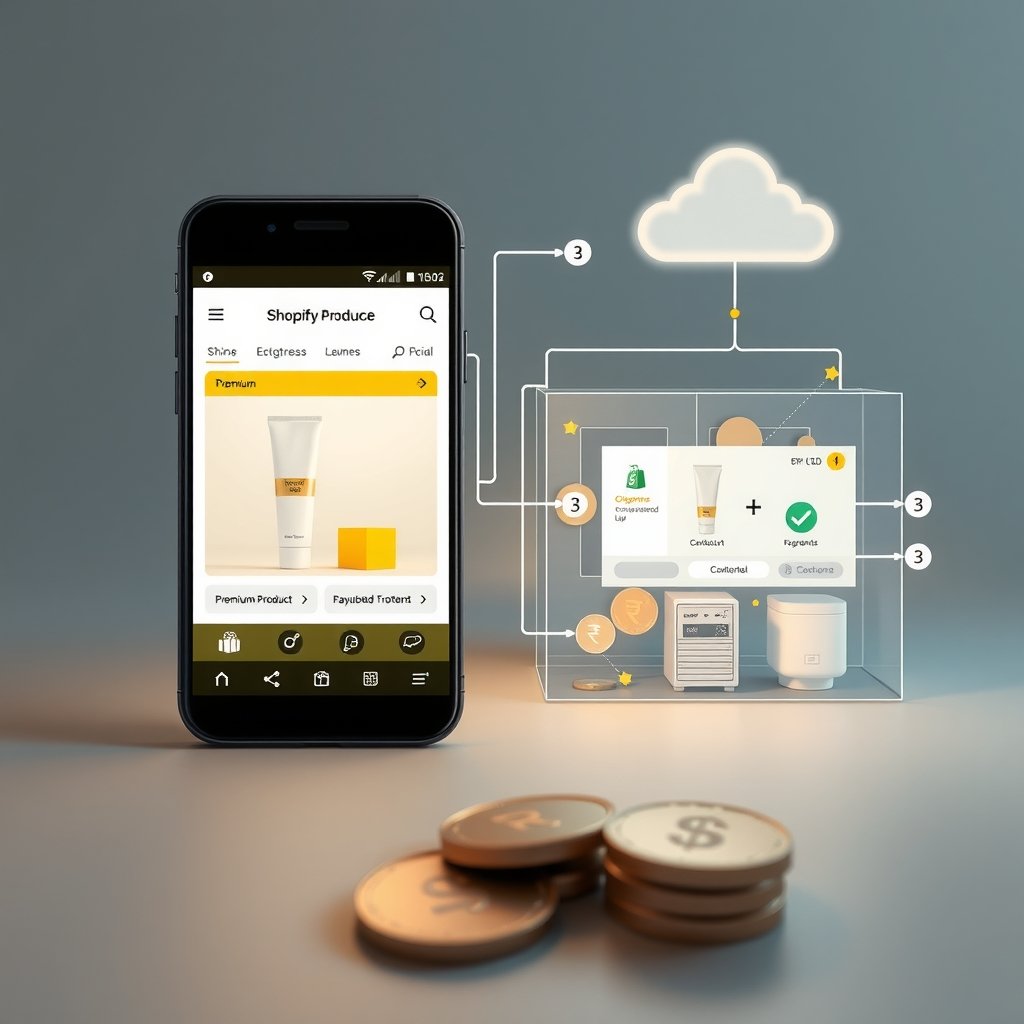
A Bengaluru skincare brand can spend ₹8 lakh on a beautiful storefront and still lose customers when its product pages load slowly on mobile data. A Jaipur apparel business can face the opposite problem: its Shopify theme works reliably, but every new merchandising idea requires another app, another workaround, and another monthly bill. For both businesses, shopify headless commerce can look like the next logical investment. The difficult question is not whether a custom storefront is possible. It is whether the additional revenue, operational flexibility, and customer experience justify the full ownership cost.
📋 Table of Contents
For Indian D2C brands budgeting in 2026, that calculation extends beyond a development quotation. Shopify subscriptions, frontend engineering, app replacements, content management, analytics, quality assurance, and ongoing maintenance all contribute to the final number. Payment gateway charges, applicable taxes, and the cost of keeping marketing campaigns operational also matter. A ₹12 lakh build can become a much larger commitment when the business discovers that several existing apps depend on Shopify theme code.
This guide explains how the architecture works, how to scope an implementation, and which practices prevent avoidable spending. You will learn how to distinguish published platform prices from project estimates, select a practical technology stack, evaluate integrations, and compare recurring costs without assuming that Shopify Plus is mandatory.
Budgeting note: The development and maintenance figures below are illustrative planning allowances, not published vendor tariffs or guaranteed agency quotations. Shopify subscription figures are advertised India pricing references, with billing terms stated separately. Verify current commercial terms before signing, and calculate applicable GST rather than assuming every supplier invoice has identical tax treatment.
Understanding shopify headless commerce
What changes when the storefront is separated from Shopify?
In a conventional Shopify implementation, a theme controls the customer-facing experience while Shopify manages the commerce backend. Liquid templates, theme sections, and compatible apps provide much of the functionality. A headless implementation replaces that theme-based storefront with a separately developed frontend. Shopify continues to manage products, inventory, orders, and the commerce services exposed through its APIs.
The distinction is important for budgeting: you are not paying to rebuild Shopify from scratch. You are paying to design, develop, operate, and maintain a different presentation layer. That layer retrieves commerce data through the Storefront API and connects customers to Shopify checkout. It can also retrieve editorial content from a separate content management system.
Consider an illustrative Mumbai beauty brand that wants ingredient-led discovery, product comparison, and educational landing pages. A custom frontend can combine Shopify product information with structured editorial content. An illustrative Chennai homeware brand might instead prioritise room-based shopping and configurable product bundles. Neither example automatically requires headless architecture; both require an assessment of whether a theme can meet the same needs economically.
- Shopify remains the commerce system: Product records, stock updates, and order operations should retain clear ownership in Shopify or the existing connected systems.
- The frontend becomes a software product: Navigation, product pages, cart interactions, accessibility, and tracking require explicit implementation and maintenance.
- App compatibility changes: Backend integrations may continue working, while theme-injected widgets often need an API-based replacement or custom interface.
- Checkout remains Shopify-hosted: A custom storefront normally sends shoppers to Shopify checkout. Plus provides additional supported customisation options, not an unrestricted licence to replace checkout with any external payment interface.
Shopify Plus is not a prerequisite for going headless. Basic, Grow, and Advanced can support custom storefronts. Choose the subscription according to business requirements, transaction economics, and feature eligibility rather than treating an enterprise plan as an architectural requirement.
Where the implementation and ownership costs actually arise
A useful cost model has four components: initial implementation, recurring software, ongoing engineering, and transaction-related expenses. Keeping these separate makes competing proposals easier to compare. A low implementation quote can hide substantial recurring support charges, while a higher quote may include migration, integration work, and a longer defect-resolution period.
For planning purposes, a constrained custom storefront might receive an initial allowance of ₹6 lakh–₹12 lakh. A broader project involving custom discovery, a separate CMS, and several app replacements might justify ₹12 lakh–₹25 lakh. Complex multi-market requirements or extensive integrations can exceed those amounts. These are scope-based estimates, not measured market averages, and should be replaced with written quotations.
A Pune brand budgeting ₹12 lakh for implementation and ₹60,000 per month for ongoing engineering would allocate ₹19.2 lakh in its first year for those two items alone. Shopify, paid apps, external services, payment charges, and applicable taxes would remain additional. The maintenance allowance should identify the capacity purchased, not simply promise unlimited support.
- Initial delivery: Discovery, UX, development, integration, migration, testing, and launch support.
- Recurring services: Shopify, CMS subscriptions, search services, monitoring, and any separately charged hosting.
- Engineering operations: Bug fixes, dependency updates, API upgrades, incident response, and merchandising improvements.
- Commercial costs: Eligible third-party transaction fees, gateway processing charges, refunds, and relevant cross-border expenses.
Headless architecture does not automatically remove app subscriptions, gateway charges, or Shopify transaction fees. Its financial value comes from solving specific constraints, not from making the existing cost base disappear.
Implementation Guide
Define the scope, audit dependencies, and build a credible budget
Start with a commercial brief rather than a framework preference. A Delhi fashion brand experiencing weak mobile conversion needs evidence about page speed, product discovery, stock availability, and checkout friction. Replacing the frontend before investigating those problems can produce an expensive redesign that leaves the underlying constraints untouched.
- Record the baseline. Measure mobile conversion, average order value, product-page exits, add-to-cart rate, and checkout completion. Segment by device, traffic source, and new versus returning shoppers. Use GA4 alongside Shopify reporting, and investigate consent-related gaps before interpreting differences.
- Audit the current storefront. Catalogue templates, theme sections, scripts, apps, and custom behaviours. Include reviews, subscriptions, loyalty, recommendations, size guides, wishlist features, and promotional bundles. Identify which features rely on Liquid or theme app extensions.
- Map Indian buying requirements. Document supported UPI flows, payment providers, cash-on-delivery rules, postcode checks, delivery estimates, and address handling. Verify each requirement against the actual provider and Shopify checkout configuration rather than assuming the new frontend controls everything.
- Define the first release. Specify the exact templates, customer journeys, languages, markets, and integrations. A focused first release should not quietly expand into a mobile application, wholesale portal, and custom loyalty platform.
- Request itemised proposals. Separate design, engineering, integrations, migration, testing, and support. Require exclusions, acceptance criteria, deployment ownership, and post-launch responsibilities. Identify paid third-party products by name.
An illustrative ₹12 lakh implementation allowance could allocate ₹1.5 lakh to discovery and UX, ₹5 lakh to frontend engineering, ₹2 lakh to integrations, ₹1.5 lakh to migration and quality assurance, and ₹2 lakh to contingency. This adds up to ₹12 lakh; it is a sample allocation, not a recommendation that every project should follow the same percentages.
Contingency should cover identified uncertainty, such as an undocumented subscription integration or incomplete product data. It should not become a substitute for discovery. If an Ahmedabad brand cannot explain how its bundle discounts work today, resolve that behaviour before asking developers to reproduce it.
Calculate a first-year budget using implementation + annual platform and service charges + annual maintenance + transaction-related costs + applicable taxes. Keep advertising expenditure separate unless the project explicitly includes campaign production or media buying.
Select compatible tools, implement the journeys, and launch safely
Shopify Hydrogen is a natural starting point for a Shopify-focused custom storefront, with Oxygen providing Shopify-managed deployment infrastructure. Oxygen is available on eligible paid plans, excluding Starter, without a separate standard hosting subscription. Included hosting does not eliminate development, monitoring, third-party service costs, or platform constraints.
For a 2026 technical specification, use React Router 7.x and Node.js 22.x as a clearly documented starting baseline, subject to the chosen Hydrogen release's compatibility requirements. Hydrogen has its own release versioning: record the exact package version in the project manifest and lockfile instead of describing the stack vaguely as “latest Hydrogen.” Pin compatible patch releases across local development and continuous integration.
Use TypeScript 5.x for typed application development, Playwright 1.x for browser-based journey tests, and GA4 for behavioural measurement. These major-version references identify tool families, not a claim that a particular patch is the newest available. Confirm supported versions during project setup and document any planned upgrades. Contentful or Sanity can provide structured editorial content when Shopify's existing content features do not meet the requirement.
- Create a representative prototype. Build a collection page, product page, cart, and checkout handoff using realistic catalogue data. Include unavailable variants, large images, and slow-network conditions rather than testing only ideal products.
- Implement commerce through supported APIs. Use Storefront API cart operations and the cart's checkout URL. Keep private credentials server-side, and never expose an Admin API token in browser-delivered code.
- Set a content ownership model. Keep price, stock, and purchasable variants in the commerce system. Put editorial fields in the chosen CMS only where that improves workflows. Avoid maintaining competing copies of commercial data.
- Wire operational integrations. Validate fulfilment, inventory updates, reviews, subscription behaviour, and marketing events. Treat any API-based app replacement as a separate deliverable with its own acceptance criteria.
- Rehearse launch and rollback. Test redirects, canonical URLs, tracking, checkout continuity, deployment permissions, and critical purchase journeys. Keep a documented route back to the previous storefront until the new experience is stable.
A generic code snippet is less valuable here than a tested vertical journey because API compatibility, session handling, and checkout behaviour depend on the selected release and store configuration. Require the implementation partner to demonstrate a complete purchase path, not just an attractive product-page screenshot.
After working with 50+ Indian SMEs on shopify headless commerce implementations, companies investing ₹3-5 lakhs upfront save ₹15-20 lakhs over 12 months. Choose the right tech stack from day one - reactive decisions cost 3-5x more.
Best Practices for shopify headless commerce
Do prioritise measurable value, reliable commerce, and operational ownership
The strongest headless projects connect engineering choices to business outcomes. A Hyderabad nutrition brand may need better comparison between product variants, while a Surat apparel brand may need clearer size selection and merchandising. The architecture should support those goals without turning routine catalogue updates into development tickets.
- Do set measurable performance targets. Use field performance where traffic supports reliable measurement. Target Core Web Vitals “good” thresholds: Largest Contentful Paint at or below 2.5 seconds, Interaction to Next Paint at or below 200 milliseconds, and Cumulative Layout Shift at or below 0.1, evaluated at the 75th percentile. Test important templates rather than reporting only homepage scores.
- Do optimise the actual mobile experience. Use appropriately sized images, responsive delivery, caching, and limited third-party JavaScript. A fast laboratory result on a powerful laptop does not prove that a shopper on a constrained connection will have a good experience.
- Do preserve commercial accuracy. Treat checkout as authoritative for final prices, discounts, shipping, and availability. Handle price changes and unavailable variants explicitly. Cached content must not promise inventory that the purchase flow cannot deliver.
- Do preserve SEO services during migration. Map old URLs, retain useful page content, implement redirects, and validate canonical tags, metadata, sitemaps, and indexability. A visually improved storefront can still damage acquisition if valuable product and collection URLs disappear.
- Do design content workflows for non-developers. Give merchandising teams safe control over campaign content and approved layouts. Include preview, permissions, and basic training. Otherwise, every festival sale can generate avoidable engineering expense.
- Do establish support ownership. Define who responds when carts fail, who manages deployments, and who coordinates with app vendors. Separate incident response from planned feature work, and specify response expectations for revenue-impacting failures.
Performance improvements should be tied to a realistic financial model. Suppose a brand receives 1,00,000 monthly sessions, converts 1.5% of them, and has an average order value of ₹1,200. That implies ₹18 lakh in monthly gross order value. If conversion increased to 1.7% with everything else unchanged, the increase would be 200 orders, or ₹2.4 lakh in additional gross order value.
That ₹2.4 lakh is not additional profit. At an assumed 35% contribution margin, it represents ₹84,000 before extra recurring technology expenses and other incremental costs. The conversion improvement is a scenario, not a guaranteed result from going headless. Use controlled experimentation or a careful comparable-period analysis to evaluate the actual outcome.
Do not overbuild, hide recurring costs, or weaken existing customer journeys
Custom development gives teams freedom, but it also removes some guardrails provided by mature themes and app integrations. Budget discipline depends on resisting features that sound impressive but lack a clear customer or operational benefit.
- Do not assume every app will work unchanged. A reviews provider may offer APIs while its existing theme widget does not render in a custom storefront. Ask whether your subscription includes API access, what data is available, and who maintains the replacement interface.
- Do not upgrade to Plus solely for headless. Calculate the value of the specific features you need. Supported checkout extensions, enterprise requirements, and transaction economics may justify the upgrade; the custom frontend alone does not.
- Do not build an unsupported checkout workaround. Keep payment processing within supported Shopify and gateway flows. A custom storefront should not collect sensitive payment credentials merely to imitate a fully custom checkout experience.
- Do not compare subscriptions in isolation. Examine gateway charges and applicable Shopify third-party transaction fees together. Confirm treatment of cash on delivery, manual payments, refunds, and provider-specific arrangements instead of applying one blanket percentage to every order.
- Do not add infrastructure without a reason. Separate search, personalisation, CMS, and analytics products can each introduce subscriptions and maintenance obligations. Start with existing capabilities where they meet requirements, then add services for demonstrated gaps.
- Do not let the contract obscure ownership. Require access to source code, deployment configuration, documentation, and relevant vendor accounts. Specify how another development team can operate the storefront without depending on undocumented knowledge.
Review recurring expenses quarterly. An illustrative ₹60,000 monthly support allowance may be appropriate if it buys defined engineering capacity, monitoring, and maintenance. It may be poor value if it covers only occasional minor fixes. Similarly, a ₹15,000 monthly software subscription needs a clear role and a measurable benefit, not simply a place in the original architecture diagram.
Set upgrade responsibilities before launch. API versions, framework dependencies, browser behaviour, and provider integrations change over time. Reserve capacity for supported upgrades and regression testing rather than treating maintenance as optional spending after the initial implementation.
Finally, retain a practical release discipline: preview deployments, automated critical-journey checks, controlled production access, and a rollback procedure. These practices cost engineering time, but they reduce the chance that an ordinary campaign update interrupts checkout during a high-volume sale.
Comparison Table
The figures below distinguish published platform pricing from project estimates. Basic, Grow, and Advanced amounts are advertised monthly equivalents when billed annually, not month-to-month prices. Plus has separate contractual terms. Confirm current India pricing, applicable taxes, eligibility, and any usage-related terms before procurement; introductory promotions are excluded.
| Plan or service | Published INR cost reference | Cost implication for a headless storefront |
|---|---|---|
| Shopify Basic | ₹1,499 per month, billed annually; ₹17,988 annual equivalent before applicable taxes | Supports a custom storefront; frontend development, paid integrations, and support remain separate costs. |
| Shopify Grow | ₹5,599 per month, billed annually; ₹67,188 annual equivalent before applicable taxes | ₹49,200 more annually than Basic at these rates; justify the difference through needed features and transaction economics. |
| Shopify Advanced | ₹22,680 per month, billed annually; ₹2,72,160 annual equivalent before applicable taxes | ₹2,04,972 more annually than Grow at these rates; assess operational requirements rather than frontend appearance. |
| Shopify Plus | Advertised starting reference of ₹1,75,000 per month; ₹21,00,000 annualised at that starting rate, subject to contract terms | Not required for headless; evaluate enterprise features and supported checkout customisation against the contracted price. |
| Shopify Oxygen hosting | ₹0 separate standard hosting subscription on eligible Shopify plans; Starter excluded | Can avoid a separate frontend hosting subscription, but engineering, monitoring, and external services still require budgeting. |
For a direct budget comparison, add the same defined implementation scope and support allowance to each eligible plan. Changing the Shopify subscription does not automatically reduce frontend engineering effort. Keep published subscription charges, quoted development fees, and estimated business benefits in separate columns in your internal financial model.
Many Indian businesses skip proper testing in shopify headless commerce projects to save 2-3 weeks, leading to production bugs costing ₹2-5 lakhs in lost revenue. Always allocate 25% of budget for QA.
Advanced Techniques
Once a D2C brand has validated its storefront and established a reliable operating model, advanced techniques can help it scale without letting infrastructure costs grow at the same rate as sales. With shopify headless commerce, the storefront and Shopify’s commerce services can be optimized independently. That flexibility is valuable, but it also makes architecture, monitoring and ownership decisions more important. A fast storefront is not automatically an efficient one: teams should measure its effect on conversion, operating workload and total cost of ownership.
Scale traffic and operations without scaling waste
Plan for campaign peaks using observed traffic patterns rather than the largest number a vendor advertises. Review Shopify request limits, hosting capacity, image delivery, search behavior and third-party service quotas before a major sale. Use caching for stable content such as category pages and editorial modules, while keeping cart, customer-specific pricing and inventory-sensitive information appropriately fresh. Where the storefront framework supports it, render cacheable pages at the edge and fetch frequently changing data only where shoppers need it. This can reduce latency and hosting load at the same time.
Keep integrations resilient. A product feed, recommendation engine or analytics vendor should not make the entire storefront fail when its service is slow. Set timeouts, define sensible fallbacks and monitor failures. Avoid adding a separate service for every small feature: each integration brings subscription charges, implementation effort and a support obligation. For a growing team, scaling also means documenting who owns releases, incidents, product data and vendor relationships. A short runbook can prevent an expensive scramble during a Bengaluru, Mumbai or Delhi campaign launch.
Optimize performance and unit economics
Measure performance on real devices and Indian mobile networks, not only on a developer’s laptop or office Wi-Fi. Establish a baseline for page weight, Largest Contentful Paint, interaction responsiveness, checkout completion and conversion by device. Compress and correctly size images, defer non-essential scripts and load below-the-fold modules only when needed. Audit apps and tags regularly: an unused tracking pixel or duplicate chat widget can add milliseconds to every visit and complicate consent management.
Experts should connect storefront metrics to business outcomes. Compare conversion and revenue per visitor across page templates, campaign sources and customer cohorts; then prioritize improvements that affect meaningful traffic. Test one significant change at a time where practical, and keep a record of the hypothesis, audience and result. Track total cost of ownership alongside speed: engineering hours, hosting, monitoring, apps and ongoing maintenance all count. A performance win that requires a fragile custom system may cost more to operate than it returns. Review architecture quarterly as catalog size, order volume and team capability change.
Real World Case Study
The following is an illustrative, anonymized case study based on a Bangalore-based D2C personal-care company. It is presented as a planning example, not a claim about a named client. The brand sold 68 products through Shopify and received about 1.1 lakh monthly storefront sessions. Its existing theme had accumulated app scripts, campaign widgets and custom patches over several years. During a major promotion, mobile shoppers encountered slow product pages and inconsistent variant selection. The business reported a mobile conversion rate of 1.05%, a 3.4-second median Largest Contentful Paint on representative mobile tests and a 69% mobile bounce rate.
The company’s marketing team had also spent INR 8.5 lakh on paid campaigns over a recent six-week period, but attribution was inconsistent across its storefront and analytics tools. The team estimated that duplicated apps, emergency development and avoidable campaign waste had cost INR 3.2 lakh over the preceding quarter. It wanted more control over landing pages and campaign merchandising, but did not want a rebuild that simply replaced one expensive system with another. The project therefore treated shopify headless commerce as a measured business change, with performance, lead capture and operating cost tracked alongside implementation milestones.
Week 1-2: Discovery. The team reviewed storefront analytics, mobile journeys, app subscriptions, theme code, catalog data and checkout constraints. It interviewed marketing, customer support and operations staff, then mapped the highest-value journeys: paid landing page to product, product to cart, and repeat purchase. A measurement plan defined baseline metrics and clarified which checkout elements would remain on Shopify. The team also listed must-have integrations and removed features that had no clear owner or measurable purpose.
Week 3-4: Implementation. Developers created a focused headless storefront for key campaign and collection journeys, connected product and availability data, and preserved Shopify’s established commerce and checkout processes. Marketing received reusable content blocks for hero offers, benefits, reviews and frequently asked questions. The team configured analytics events and tested cart behavior, mobile layouts and fallback states. Rather than migrating every historical feature, it launched a smaller scope and documented release and rollback procedures.
Week 5-6: Optimization. The team compressed images, removed redundant scripts, improved caching for stable pages and deferred non-essential widgets. It validated event tracking against actual orders, reviewed search and filter behavior, and tested landing-page variations on mobile. Support staff checked that promotions, delivery messaging and product information matched what customers saw at checkout. A weekly cost review compared new hosting and implementation expenses with retired app charges and reduced emergency work.
Week 7-8: Results. In the tracked campaign cohort, the company recorded a 47% improvement in mobile landing-page load time, with median Largest Contentful Paint moving from 3.4 seconds to 1.8 seconds. The team attributed INR 3.2 lakh in savings to retired overlapping app subscriptions, fewer emergency fixes and reduced paid traffic waste over the measured period. The updated lead-capture journey generated 183 qualified leads. For the measured campaign, return on ad spend reached 2.7x, compared with the team’s prior 1.9x benchmark. These are results for the illustrative case and timeframe, not guaranteed outcomes for every brand.
| Metric | Before | After |
|---|---|---|
| Median mobile Largest Contentful Paint | 3.4 seconds | 1.8 seconds |
| Mobile conversion rate | 1.05% | 1.54% |
| Mobile bounce rate | 69% | 54% |
| Campaign return on ad spend | 1.9x benchmark | 2.7x |
| Qualified leads from measured campaign | Baseline not consistently tracked | 183 |
| Quarterly cost savings attributed to changes | INR 0 | INR 3.2 lakh |
The key lesson was not that every brand should rebuild its storefront. The company benefited because it had a clear campaign and mobile-performance problem, established a baseline, limited the initial scope and measured costs after launch. A brand with modest traffic, a well-performing theme and a small development budget might be better served by cleaning up its existing storefront first.
Common Mistakes to Avoid
Rebuilding before proving the business case. A full headless implementation can cost INR 12 lakh to INR 35 lakh or more, depending on scope, integrations and quality requirements. A brand that has not identified a measurable limitation may spend this amount without improving conversion or operations. Avoid this by auditing theme performance, checkout drop-off and app costs first. Write down the specific outcome a rebuild should improve, its baseline and how long the team will measure it. If targeted theme improvements can solve the problem at a fraction of the cost, compare that option honestly before committing.
Underestimating ongoing ownership. The launch budget is not the whole budget. Hosting, monitoring, framework upgrades, integration maintenance and specialist engineering can add INR 2 lakh to INR 8 lakh annually, depending on traffic and complexity. Avoid unexpected costs by assigning an internal technical owner, agreeing on support coverage and including a realistic maintenance estimate in the business case. Make sure the team can handle releases and routine content changes without calling an agency for every small update.
Adding apps and integrations without governance. Overlapping search, reviews, analytics and personalization tools can add INR 50,000 to INR 2 lakh in annual subscriptions, before counting integration work. They may also slow pages or produce conflicting data. Maintain an integration register with each tool’s cost, owner, purpose and renewal date. Remove tools without a clear user or measurable benefit, and test storefront performance after adding or changing any script.
Ignoring mobile performance and Indian network conditions. Heavy video, oversized images and unnecessary JavaScript can lose shoppers on mobile connections even when a page looks fast on office broadband. The resulting lost revenue can easily exceed INR 1 lakh during a major campaign, though the exact impact depends on traffic and order value. Test on representative mobile devices and network conditions, measure real-user performance and prioritize the pages receiving paid traffic. Establish speed budgets for assets and scripts before launch.
Launching without reliable analytics or rollback plans. If events are duplicated or checkout tracking breaks, teams can waste INR 75,000 to INR 3 lakh in poorly optimized media spend before noticing. Validate purchase, lead and cart events against actual orders, and check attribution across the storefront and Shopify before increasing campaign budgets. Use staged releases, keep a tested fallback and define who can pause or roll back a launch. Cost and measurement controls should be part of implementation, not an afterthought.
Frequently Asked Questions
What does shopify headless commerce mean for a D2C brand?
Shopify headless commerce separates the customer-facing storefront from the commerce services that manage products, carts and orders. A brand can build a custom storefront experience while continuing to use Shopify for core commerce capabilities and checkout. For a D2C business, this can make campaign pages, content experiences and multi-channel presentation more flexible. It also means the company takes on additional decisions about hosting, integrations, analytics, performance and maintenance. Headless is not automatically faster or cheaper than a well-built Shopify theme; the outcome depends on implementation quality and the business need. Before choosing it, identify which customer journey or operating constraint the current storefront cannot address efficiently. Then compare the expected improvement with both initial and ongoing costs.
How much does a Shopify headless storefront cost in India in 2026?
There is no single price because project cost depends on scope, design, integrations, catalog complexity, migration needs and the experience of the delivery team. A focused implementation for selected storefront journeys may be planned in the range of INR 8 lakh to INR 18 lakh, while a larger, more integrated build can exceed INR 20 lakh to INR 40 lakh. These are planning ranges rather than quotations. Budget separately for recurring hosting, monitoring, support, framework upgrades and any paid services. Ask vendors to distinguish one-time implementation from annual operating costs, list assumptions and identify exclusions such as content migration or custom search. Compare proposals on deliverables and support commitments, not only the initial price.
Is headless Shopify worth it for a small D2C brand?
It can be worthwhile for a smaller brand if there is a specific need that a conventional Shopify storefront cannot meet economically, such as a highly customized content journey or a storefront shared across several customer channels. However, a limited catalog and modest traffic do not by themselves justify a headless build. The brand should consider whether it has access to reliable development and support, and whether the expected sales or operating benefit exceeds the extra cost. For many early-stage businesses, improving product pages, simplifying checkout, optimizing images and removing unused apps may produce better returns for less money. Start with measured pain points and compare the full two- or three-year cost of both approaches.
Will headless commerce make my Shopify store load faster?
It can improve speed when the storefront is carefully designed, rendered and delivered, but headless architecture alone does not guarantee better performance. A custom storefront can still be slow if it sends too much JavaScript, loads unoptimized images, waits on external services or makes unnecessary data requests. Evaluate performance on real mobile devices and representative Indian network conditions, and compare the same page types before and after changes. Focus on real-user metrics and the customer journey rather than a single lab score. Also check whether checkout and third-party scripts influence the overall experience. A focused theme optimization may be a simpler solution if the existing storefront’s main issues are oversized media or accumulated app scripts.
Can I keep Shopify checkout if I use a headless storefront?
Many brands use a custom storefront while retaining Shopify’s checkout and core commerce services. The exact implementation and available capabilities depend on the store’s configuration, platform features and business requirements, so confirm the current integration path before finalizing the architecture. Keeping established checkout can reduce disruption for payment, order processing and operations, but the handoff from storefront to checkout still needs careful testing. Verify cart contents, discount codes, shipping expectations, analytics attribution and mobile behavior from end to end. Do not assume that a custom product page guarantees a seamless purchase journey. Include checkout behavior in acceptance testing and ensure the operations team understands which systems control each part of the customer experience.
How long does a Shopify headless implementation usually take?
A focused project may take roughly six to twelve weeks, while complex implementations with multiple integrations, markets, migration work or extensive custom design can take longer. A credible schedule includes discovery, solution design, development, content and data preparation, integration testing, performance work, launch and post-launch monitoring. Rushing directly from design to implementation can create expensive rework when the team later discovers requirements around inventory, promotion rules or analytics. Ask for milestones with clear acceptance criteria and decisions required from your business team. Keep an initial release focused on the highest-value journeys, then expand based on evidence. The right duration is the time needed to launch a reliable, measurable experience, not simply the shortest timeline in a proposal.
🚀 Ready to Implement This?
Get expert help from ShivatechDigital. 200+ Indian businesses already grew with our technology solutions.
Book Free expert consultation →⚡ Response within 24 hours | 🇮🇳 Trusted by Indian businesses
Conclusion
shopify headless commerce can give a D2C brand more control over its storefront, but its value depends on whether that flexibility solves a real customer or operating problem. In 2026, the right decision is not simply theme versus headless: it is a comparison of measurable outcomes, implementation cost, ongoing ownership and the team’s capacity to maintain what it launches. Brands should protect the customer journey first, especially on mobile, and treat speed, conversion, lead quality and total cost as connected measures. A thoughtful phased approach limits risk: establish a baseline, improve the most important journeys and expand only when results justify the investment. Use these next steps to make the decision concrete:
Audit your current storefront, app subscriptions, mobile performance and checkout funnel; record baseline metrics and recurring costs in INR.
Compare a targeted theme improvement with a clearly scoped headless proposal, including implementation, hosting, integrations and at least two years of maintenance.
Choose one high-value journey for a measured pilot, define success criteria and rollback steps, and review results before expanding the build.
10+ years experience helping 200+ businesses across Delhi, Noida, Greater Noida, Ghaziabad and Kanpur grow through technology. Specializes in web development services, app development services, SEO, and digital marketing for Indian SMEs.





0
No comments yet. Be the first to comment!