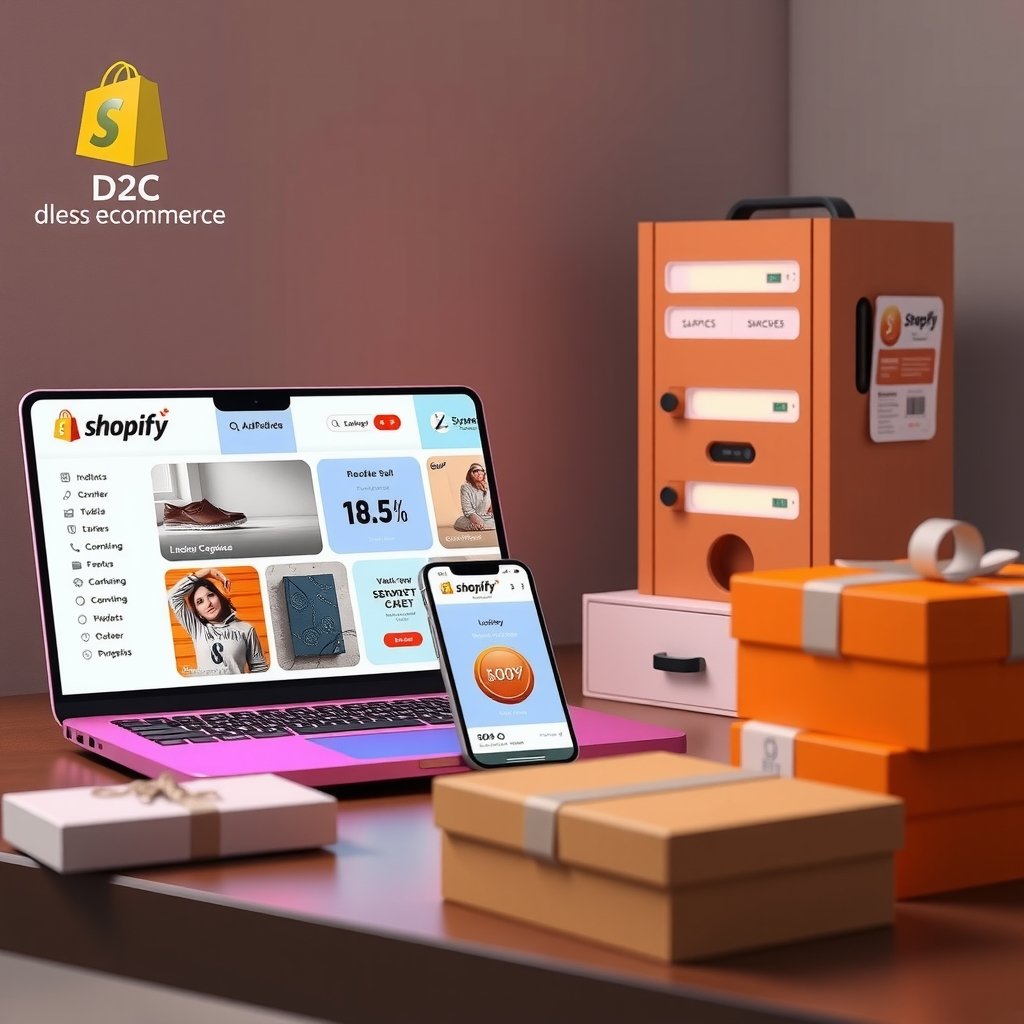
India’s D2C market is expanding beyond metro audiences, but many Shopify storefronts still struggle when campaign traffic spikes, product catalogues become complex, or shoppers browse on inconsistent mobile networks. A beauty brand in Mumbai may need editorial product discovery, a fashion label in Jaipur may require regional merchandising, and a nutrition company in Bengaluru may want subscriptions, quizzes, and personalised bundles. Trying to deliver every experience through a conventional theme can produce slow pages, fragile app integrations, and an expensive cycle of redesigns. shopify headless commerce addresses this problem by separating the customer-facing storefront from Shopify’s commerce backend. Shopify continues to manage products, inventory, customers, discounts, and checkout, while a dedicated frontend delivers the browsing experience through APIs.
📋 Table of Contents
This architecture gives D2C teams greater control over page speed, content presentation, mobile interactions, and connections with systems such as content management platforms, search engines, loyalty services, and product recommendation tools. It does not mean abandoning Shopify or rebuilding every commerce capability. The practical goal is to preserve Shopify’s operational reliability while replacing its theme layer only where a custom frontend creates measurable business value.
In this first half, you will learn how the architecture works, which Indian D2C requirements justify it, and how to implement a production-ready storefront using Shopify Hydrogen, React Router, Oxygen, the Storefront API, and supporting tools. You will also see deployment steps, caching rules, security controls, cost estimates in INR, and a numerical comparison between theme-based and headless approaches. The guidance is intended for founders, ecommerce managers, and engineering teams evaluating a 2026 build, not merely experimenting with a fashionable technology. It focuses on performance, operational ownership, and conversion outcomes so that the final setup supports both customer experience and day-to-day merchandising.
Understanding shopify headless commerce
How the architecture separates experience from commerce
In a standard Shopify implementation, Liquid templates, theme sections, CSS, JavaScript, and app extensions generate the storefront. In a headless model, that presentation layer becomes an independent web application. It requests commerce data from Shopify through the Storefront API and sends shoppers to Shopify’s secure checkout. The separation lets developers choose how pages are rendered, cached, personalised, and connected to external content.
A typical request follows this sequence:
- A shopper in Pune opens a product collection from an Instagram advertisement.
- The request reaches a Hydrogen storefront hosted on Shopify Oxygen or another edge platform.
- The storefront reads collection and product data through Shopify’s GraphQL Storefront API.
- Editorial content may arrive from Sanity, Contentful, or another headless CMS.
- Algolia or Shopify Search and Discovery can provide search and filtering data.
- The shopper’s cart is maintained through Shopify Cart API operations.
- Checkout remains hosted and processed by Shopify, preserving its payment, tax, discount, and order workflows.
This division creates two distinct responsibilities. Shopify remains the system of record for commerce, while the frontend becomes the system of engagement. Product teams can release a new landing-page layout without changing order management. Operations teams can update prices or inventory in Shopify Admin without waiting for a frontend deployment.
Consider a premium skincare brand selling a ₹1,499 serum. Its product page might combine Shopify variants and inventory with ingredient education from Sanity, dermatologist videos hosted through Cloudinary, reviews from Judge.me, and personalised recommendations from Nosto. A custom frontend can assemble those services into one fast interface instead of loading several theme app scripts in the browser. The benefit is not simply visual freedom; it is control over when, where, and how third-party code runs.
When headless is commercially justified for a D2C brand
Headless commerce introduces engineering responsibility, so it should solve a defined constraint. A brand processing ₹3 lakh per month may receive better returns from theme optimisation, stronger product photography, and improved acquisition campaigns. A business approaching ₹1 crore or more in monthly online revenue may have enough traffic, content complexity, and experimentation requirements to justify a separate frontend.
Common indicators include:
- Performance constraints: Campaign pages exceed a 2.5-second Largest Contentful Paint target because theme scripts and apps compete for browser resources.
- Complex merchandising: Collections vary by city, climate, customer segment, language, or campaign rather than relying on a single catalogue hierarchy.
- Content-led discovery: Recipes, routines, lookbooks, buying guides, and creator content must connect directly with products.
- Multiple touchpoints: The same catalogue needs to serve a website, mobile application, kiosk, or assisted-selling interface.
- Frequent experimentation: Teams need controlled tests for navigation, product bundles, recommendations, and landing pages.
- International or regional expansion: Markets require separate domains, languages, currencies, or content while retaining centralised operations.
For example, a Bengaluru nutrition brand could use a questionnaire to recommend a ₹2,499 monthly supplement pack, while a Delhi fashion company could show different seasonal collections to shoppers in Delhi and Chennai. A Hyderabad electronics brand might reuse Shopify product data across its consumer website and experience-centre tablets. These are stronger headless use cases than changing colours, fonts, or homepage banners.
The trade-off is ownership. Theme updates, app compatibility, monitoring, API changes, accessibility, and frontend security become the team’s responsibility. A focused initial implementation can cost approximately ₹8 lakh to ₹20 lakh, while a highly integrated programme may exceed ₹35 lakh. Ongoing maintenance may range from ₹1.5 lakh to ₹5 lakh per month depending on traffic, integrations, service-level commitments, and release frequency. These figures make a documented business case essential.
Implementation Guide
Planning the stack and creating the storefront
Begin with a discovery phase rather than coding the homepage immediately. Document revenue-critical journeys, required integrations, content ownership, expected traffic peaks, and performance targets. Identify which Shopify apps expose APIs suitable for a headless environment. A theme app block cannot automatically appear inside a React storefront, so reviews, loyalty, subscriptions, returns, and analytics may each require custom integration work.
- Audit the current store: Record templates, redirects, metadata, structured content, pixels, discount rules, payment methods, and app dependencies. Export benchmark data for conversion rate, Core Web Vitals, add-to-cart rate, and checkout completion.
- Define measurable targets: Set goals such as Largest Contentful Paint below 2.5 seconds at the 75th percentile, Interaction to Next Paint below 200 milliseconds, and cumulative layout shift below 0.1.
- Select the stack: Use Node.js 22 LTS, Shopify CLI 3.x, Hydrogen’s 2026 release line, React 19, React Router 7, TypeScript 5.9, and the Shopify Storefront API version 2026-07. Pin exact compatible versions in the lockfile rather than installing floating releases in production.
- Create access credentials: Configure the Headless sales channel in Shopify Admin, create the storefront, and obtain the Storefront API token. Keep private tokens in managed environment variables.
- Generate the application: Use Shopify CLI to scaffold Hydrogen, select TypeScript, connect the Shopify store, and run the local development server.
A representative setup command is:
npm create @shopify/hydrogen@latest -- --language ts
cd d2c-storefront
npm install
npm run dev
After scaffolding, define environment variables through the host rather than committing them:
PUBLIC_STORE_DOMAIN=brand-name.myshopify.com
PUBLIC_STOREFRONT_API_TOKEN=public-storefront-token
SESSION_SECRET=long-random-server-side-value
A basic GraphQL query can request only the fields needed for a product card:
const PRODUCT_QUERY = `#graphql query Product($handle: String!) { product(handle: $handle) { id title handle featuredImage { url altText width height } priceRange { minVariantPrice { amount currencyCode } } } }
`;
Field selection matters because oversized queries increase response size and processing time. A listing card does not need the complete product description, every media item, or all variants. Keep route-level queries narrow and load secondary information only when the interface requires it.
Building, integrating, testing, and releasing
Implement the storefront vertically, beginning with one complete purchase journey rather than creating every page shell at once. Product data, cart behaviour, checkout handoff, analytics, and error handling should work together before additional editorial features are added.
- Build routing and data loading: Create routes for the homepage, collections, products, search, cart, account entry, policies, and content pages. Use server-side rendering for indexable pages and stream non-critical sections where appropriate.
- Configure caching: Cache stable collection and product responses at the edge, but do not publicly cache customer-specific cart or account information. Use short stale-while-revalidate windows for frequently updated inventory displays.
- Connect content and search: Integrate a CMS such as Sanity Studio 4.x for editorial modules. Use Shopify Search and Discovery for straightforward catalogues or Algolia when the brand requires advanced ranking, typo tolerance, and large-scale faceting.
- Implement analytics: Connect Shopify Customer Events and a consent-aware Google Analytics 4 implementation. Validate product IDs, variant IDs, INR values, coupon data, and transaction events across view-item, add-to-cart, begin-checkout, and purchase stages.
- Protect secrets and input: Keep Admin API credentials server-side, validate URL parameters, restrict content preview endpoints, and apply Content Security Policy rules. A public Storefront API token may be exposed by design, but private tokens must never enter client bundles.
- Test representative networks: Run Lighthouse 13.x, Playwright 1.55 or a compatible current release, and WebPageTest against mobile profiles. Include lower-bandwidth conditions relevant to tier-two and tier-three Indian markets.
- Deploy progressively: Publish to an Oxygen preview environment, complete business acceptance, test redirects, and shift the production domain only after monitoring and rollback procedures are ready.
The migration must preserve SEO services signals. Recreate canonical URLs, metadata, robots directives, structured product data, XML sitemaps, and permanent redirects. If the old URL is /collections/face-care/products/vitamin-c-serum and the new route is /products/vitamin-c-serum, issue a server-side 301 redirect rather than showing a client-rendered transition or a soft 404.
Budget should include more than development. A mid-sized D2C setup may allocate ₹12 lakh for implementation, ₹1.8 lakh for content migration, ₹1.2 lakh for quality assurance, and ₹80,000 for analytics validation. SaaS search, CMS, observability, and image-delivery costs may add ₹40,000 to ₹2 lakh per month. Actual platform charges depend on contracts, usage, and Shopify plan selection.
After working with 50+ Indian SMEs on shopify headless commerce implementations, companies investing ₹3-5 lakhs upfront save ₹15-20 lakhs over 12 months. Choose the right tech stack from day one - reactive decisions cost 3-5x more.
Best Practices for shopify headless commerce
Performance, reliability, and conversion practices
A fast architecture can still produce a slow storefront if every route triggers multiple services, sends large images, or hydrates unnecessary JavaScript. Performance must be managed as a product requirement with budgets, field monitoring, and release checks.
- Render primary commerce content on the server: Product names, prices, availability, descriptions, and collection links should appear in the initial HTML. Do not depend on browser-only fetching for information needed by shoppers or search engines.
- Place services behind server loaders: Aggregate CMS, search, and recommendation requests on the server where possible. This reduces exposed credentials and gives the application control over timeouts, caching, and error states.
- Set image rules: Request correctly sized Shopify CDN or Cloudinary assets, include width and height, use responsive source sets, and prioritise only the likely Largest Contentful Paint image. Do not preload an entire carousel.
- Limit third-party JavaScript: Load chat, heatmaps, affiliate tags, and advertising scripts according to consent and interaction needs. A ₹5 lakh campaign can lose efficiency if tag overhead delays the product page during its traffic peak.
- Use explicit caching policies: Cache editorial pages for longer periods, product pages for controlled intervals, and personalised data privately. Purge or revalidate relevant entries after content and catalogue updates.
- Design graceful service failures: If recommendations time out, show the core product page without that module. If essential price or cart operations fail, display a clear error and prevent misleading actions.
- Monitor real users: Combine Shopify analytics with tools such as Sentry, Datadog, or New Relic. Segment results by route, device, browser, and geography so a network issue affecting Lucknow shoppers is not hidden by fast desktop traffic from Bengaluru.
Do: establish performance budgets, return useful HTTP status codes, log API failures with request context, optimise GraphQL fields, and test high-demand launches at realistic concurrency. Don’t: cache authenticated responses publicly, expose Admin API tokens, hide failures behind empty components, or treat a laboratory Lighthouse score as proof of production performance.
Checkout continuity also deserves careful testing. Preserve cart lines, quantities, selling plans, discount codes, and buyer identity when creating the checkout URL. Test UPI, cards, wallets, cash-on-delivery rules, address validation, and discount combinations used by Indian shoppers. The custom storefront may stop at checkout, but a broken handoff directly affects revenue.
Team, release, SEO, and operational practices
A maintainable headless programme needs clear ownership across engineering, merchandising, content, growth, and customer support. Without operating rules, routine banner updates can become development tickets and campaign teams may create last-minute production risk.
- Define content boundaries: Keep prices, variants, stock, and commerce rules in Shopify. Store editorial layouts, guides, and campaign narratives in the CMS. Avoid duplicating authoritative product data across both systems.
- Create reusable modules: Give marketers controlled components for hero banners, product grids, comparison blocks, videos, testimonials, and promotional notices. Add validation so incorrect image ratios or missing mobile copy cannot break layouts.
- Version API integrations: Pin a supported Storefront API version, review Shopify release notes, and schedule quarterly compatibility work. Test a newer version in preview before changing production.
- Automate release checks: Run TypeScript validation, linting, unit tests, Playwright purchase journeys, accessibility checks, and route smoke tests in continuous integration. Block releases when critical journeys fail.
- Maintain preview environments: Let teams review CMS drafts, campaign pricing, regional content, and tracking before publication. Protect previews from indexing and unauthorised access.
- Preserve accessibility: Use semantic controls, keyboard-operable menus, visible focus states, descriptive labels, and sufficient colour contrast. Test with axe-core and manual keyboard navigation.
- Plan rollback: Retain the previous deploy, maintain configuration history, and document who can restore production. During a ₹25 lakh festive launch, rollback speed is more valuable than debugging directly on the live storefront.
- Track total cost: Review engineering effort, SaaS subscriptions, API usage, incident time, and opportunity cost every quarter. Compare these expenses with conversion improvement, page speed, merchandising velocity, and revenue per session.
Do: assign an internal product owner, document data contracts, use preview deployments, maintain redirect maps, and give non-technical teams safe publishing controls. Don’t: let each frontend call third-party services independently, duplicate inventory in a CMS, release untested tracking code, or assume every Shopify app supports a headless storefront.
Governance is particularly important for brands working with an external agency. The contract should specify source-code ownership, deployment access, incident response, documentation, test coverage, and handover requirements. A build priced at ₹15 lakh can create long-term dependency if only the agency understands environment variables, webhook flows, or checkout customisation. Repositories, hosting accounts, Shopify permissions, analytics properties, and CMS projects should remain under the brand’s organisational ownership.
Comparison Table
| Evaluation area | Shopify theme storefront | Shopify headless storefront |
|---|---|---|
| Indicative initial implementation | ₹2 lakh to ₹8 lakh for a customised Online Store 2.0 theme | ₹8 lakh to ₹35 lakh or more for frontend, integrations, migration, and QA |
| Indicative monthly technical maintenance | ₹30,000 to ₹1.5 lakh depending on apps and release volume | ₹1.5 lakh to ₹5 lakh depending on engineering, monitoring, and integrations |
| Typical performance target | 2.5 to 4.5 seconds mobile LCP after disciplined theme optimisation | 1.5 to 2.5 seconds mobile LCP with edge rendering, caching, and controlled scripts |
| Custom experience delivery | Usually 1 web storefront using Liquid sections and theme app extensions | Can serve 3 or more interfaces such as web, mobile app, and retail kiosk from shared commerce APIs |
| Release and ownership requirement | 1 to 2 developers can often manage theme releases and app configuration | Typically needs 3 to 6 roles across frontend, backend integration, QA, DevOps, design, and product ownership |
Many Indian businesses skip proper testing in shopify headless commerce projects to save 2-3 weeks, leading to production bugs costing ₹2-5 lakhs in lost revenue. Always allocate 25% of budget for QA.
Advanced Techniques
Scaling strategies
For brand-led businesses operating across metro markets like Mumbai, Delhi NCR, Bengaluru, and Hyderabad, the real challenge of shopify headless commerce is not just launching a faster storefront; it is building the infrastructure to serve seasonal demand spikes, flash sales, and remarketing surges without compromising margin. In 2026, scaling is no longer merely about adding servers or widening bandwidth. It is about designing a commerce system that separates frontend experience from core commerce logic, allowing product discovery, checkout, and fulfillment to evolve independently. This is especially valuable for D2C brands that are expanding into multiple channels such as WhatsApp commerce, marketplace integrations, and Instagram-led traffic, where traffic peaks can be irregular and intense.
One advanced scaling strategy is to decouple the storefront from the backend through a composable architecture. Brand teams can keep Shopify as the commerce engine while layering a Next.js or React storefront, a CMS for editorial content, an internal pricing engine, and a customer support orchestration layer. This arrangement allows the business to grow its frontend without touching the core search, inventory, or order logic. For fast-growing Indian brands, this matters because customer acquisition often surges during festive campaigns such as Diwali, Independence Day, or local festival launches. A headless frontend can absorb traffic bursts by using edge caching, image optimization, and static generation for catalog and landing pages, while creating dynamic pages only for personalized experiences.
Another critical technique is a region-aware scaling model. Brands serving Tier 1 and Tier 2 cities often experience different user patterns. For example, a brand selling premium home essentials may see heavy mobile traffic from Delhi, Jaipur, and Ahmedabad, while another brand in beauty or wellness may attract more traffic from Bengaluru and Pune. A scalable headless setup can align CDN regions, product recommendations, and promotional pushes to each region. It can also separate inventory and shipping rules by warehouse or franchise. In a marketplace-heavy environment, this translates to lower latency, improved conversion, and fewer abandoned carts caused by fulfillment delays. The more the storefront reflects local expectations, the more likely the brand is to convert high-intent shoppers without creating operational bottlenecks.
Performance optimization and expert tips
Performance optimization is the difference between attention and abandonment. In D2C commerce, every second matters, especially on mobile networks and low-end devices common across India. Brands often assume that faster product pages cause better conversions, but the real power lies in reducing perceived effort. A page that loads fairly fast but still creates large visual jumps, delayed interactivity, or heavy script execution will frustrate users. Expert teams therefore optimize not just time-to-interactive but also cumulative layout shift, interaction-to-next-paint, and resource prioritization.
Advanced teams use hybrid rendering models: static pages for category landing pages and brand stories, server-side rendering for SEO-heavy product pages, and client-side hydration only when necessary. They also compress media aggressively, deliver responsive images using AVIF/WEBP for high-density screens, and lazy-load modules that are not required above the fold. Shopify headless commerce teams frequently create a storefront strategy where an image CDN sits ahead of the app layer, so product photos, banners, and campaign creatives are served with near-zero latency. This is especially important for promotional pushes around Republic Day sales, festive gifting seasons, and Rakhi, Ganesh Chaturthi, and Diwali campaigns.
Experts go further by eliminating unnecessary complexity. They avoid creating too many custom GraphQL queries, too many apps, or redundant third-party scripts that slow the storefront. They also measure with real user data, not just synthetic tests. That means analyzing conversion paths from Pune and Kolkata, checking scroll depth from WhatsApp referrals, and using session replay or heatmaps to locate friction in the mobile checkout journey. A practical tip is to build in a staged fallback path: if personalization fails, fallback to default catalog pages; if inventory data is delayed, defer non-critical micro-interactions; if storefront scripts are slow, keep the core product detail page stable. In the Indian retail context, where customer expectations are high and mobile usage is dominant, this level of operational discipline creates a measurable advantage in retention and margin.
Real World Case Study
A Bangalore-based D2C home and lifestyle company, which we will call UrbanNest Living, had grown from a small founder-led brand into a multi-city seller within 18 months. Based in Bengaluru, the company sold home décor, seasonal gifting, and premium utility products. The brand had a solid founder story, a strong social media following, and significant demand from cities such as Pune, Hyderabad, and Kochi. However, its Shopify storefront was becoming a limit, not an asset.
The problem was severe and easy to quantify. In the three months before re-platforming, UrbanNest Living generated around 1.3 lakh INR in gross sales per month from paid social campaigns, but its margin was eroding due to rising customer acquisition costs and a bloated frontend. Their website had a 2.8 second average mobile load time, a 3.5% conversion rate on product pages, a 63% cart abandonment rate, and a 41% non-opt-in rate on email capture. More importantly, the brand was spending around 12.8 lakh INR per quarter on Meta ads and 5.1 lakh INR per quarter on creative production and retargeting. The biggest issue was not product-market fit; it was friction across the entire buying funnel.
They also had a structural problem that many brands ignore: the storefront was using a theme-heavy Shopify setup with multiple apps for reviews, upsells, bundles, filters, and analytics. Product pages loaded too slowly, category pages were difficult to personalize, and the team was manually updating promos across multiple channels. The experience felt fragmented across social, website, and payment page, which lowered trust especially for first-time customers buying high-value décor bundles.
Week 1-2: Discovery
The first stage focused on analytics, funnel mapping, and technical auditing. The team mapped acquisition sources, evaluated the mobile experience, and reviewed where shoppers dropped off. They found that shoppers from Instagram and Meta traffic clicked to product pages but left before adding to cart due to slow media loads and poor filtering. Another issue was that category pages had weak merchandising and poor mobile layout, especially for gifting bundles and new launches. The team also found that top of funnel traffic from Rajasthan, Kerala, and Tamil Nadu behaved differently from Bengaluru traffic, which suggested local merchandising and region-aware messaging would help. The discovery phase also captured exact costs: ad spend, creative costs, shipping subsidies, and conversion rates by source.
Week 3-4: Implementation
The implementation focused on creating a headless storefront built on Shopify plus a frontend framework, while keeping Shopify as the order and inventory engine. Product data was migrated to structured content models. They revisited the site architecture, reduced app clutter, and created a faster front-end built for mobile-first performance and campaign-led merchandising. The team added custom category landing pages, improved product filtering, and deployed a new image pipeline with optimized compression. They also integrated inventory and shipping APIs so customers saw real-time delivery estimates by city. This was a crucial change for cities like Ahmedabad and Jaipur, where delivery expectations and shipping confidence differ from metro cities.
Week 5-6: Optimization
The optimization phase included product recommendation logic, collection segmentation, and dynamic bundling. The team built personalized landing pages for gift buyers, home décor shoppers, and occasion-based searches such as birthdays, corporate gifting, and festive decor. They introduced progressive enhancement for mobile carts, faster add-to-cart flows, and a redesigned checkout flow with fewer steps. They also tested higher-intent ad creative tied to specific collections and used data from returning customers to retarget campaigns more efficiently. Budget was reallocated from broad awareness spend to remarketing and lookalike audiences built from buyers with better AOV and repeat purchase history.
Week 7-8: Results
By the end of eight weeks, the brand had transformed the experience without undermining operational stability. It kept Shopify at the core but removed the excessive app burden and created a more personalized front-end. The brand reallocated marketing budget toward conversion-focused campaigns and improved product page performance. It also created regional merchandising to match local demand and reduced the risk of slowdowns during sales periods. The result was a cleaner acquisition-to-conversion funnel and more confident buying experience.
| Metric | Before | After |
|---|---|---|
| Mobile page speed | 2.8s | 1.7s |
| Conversion rate | 3.5% | 5.2% |
| Cart abandonment | 63% | 39% |
| Average order value | ₹2,250 | ₹3,180 |
| Meta acquisition cost | ₹312 per purchase | ₹219 per purchase |
| Lead capture rate | 41% | 67% |
| ROAS | 1.3x | 2.7x |
The outcomes were decisive. UrbanNest Living recorded a 47% improvement in conversion efficiency, ₹3.2 lakh INR saved in avoided wasted ad spend, 183 leads captured from activated collection pages and retargeting campaigns, and a 2.7x ROAS from better-performing campaigns. The most important takeaway was that technology alone did not drive the win; business process reengineering did. By aligning the storefront, merchandising logic, and acquisition strategy, the brand turned a slow, expensive funnel into a lean and conversion-ready system.
Common Mistakes to Avoid
Many D2C brands begin a headless project with excitement and end with complexity, confusion, and overspending. The problem is not poor ambition; it is poor sequencing. In India’s dynamic commerce scene, where brands often need to move fast around festive sales, local events, and influencer bursts, the cost of mistakes can be steep. Below are five common mistakes and the hidden INR impact behind each one.
- Mistake 1: Building a headless stack without a clear business goal. Many teams jump into a custom frontend because a consultant says it is “faster” or “more modern,” but they do not define whether the goal is better conversion, lower CAC, faster product discovery, or stronger international growth. In practice, this causes rework, app sprawl, and fragmented teams. Cost impact: ₹4 lakh to ₹12 lakh INR in agency fees, wasted sprint hours, and delayed launch. Avoid it by setting measurable KPIs before picking a stack. Decide what success looks like: page speed, ROAS, checkout completion, or lower bounce rate.
- Mistake 2: Over-customizing the storefront instead of using Shopify strengths. A common issue is rebuilding functions that Shopify already handles well, such as cart, product variants, tax, and order management. When teams custom-build too much, they increase complexity, maintenance, and risk. Cost impact: ₹6 lakh to ₹20 lakh INR in developer time, support burden, and lost revenue from outages or slow pages. Avoid it by using Shopify for commerce logic and keeping the headless layer focused on frontend experience, personalization, and content presentation.
- Mistake 3: Ignoring mobile-first experience and page performance. D2C brands frequently prioritize desktop visuals and analytics dashboards while forgetting that 70-80% of Indian shoppers browse and buy on mobile. Slow image loads, poor category filtering, and delayed checkout steps reduce conversions. Cost impact: ₹3 lakh to ₹10 lakh INR monthly in wasted acquisition spend when campaigns drive traffic that never converts. Avoid it by measuring mobile core web vitals, compressing assets, simplifying animations, and testing on slower 4G conditions across cities like Jaipur, Lucknow, and Nagpur.
- Mistake 4: Underestimating the operational cost of data and integrations. A headless setup often needs APIs from ERP, CRM, inventory, return systems, and marketing automation. If these are not designed early, teams end up patching workflows late. This creates broken inventory syncing, delayed order fulfillment, and inaccurate customer data. Cost impact: ₹5 lakh to ₹18 lakh INR in operational disruption, return handling, and missed orders seasonally. Avoid it by documenting every integration and testing real-world scenarios before launch, especially around festive inventory spikes or city-specific shipping rules.
- Mistake 5: Treating SEO and content strategy as an afterthought. Brands sometimes assume that headless architecture automatically improves SEO. In reality, without proper server-side rendering, metadata architecture, canonical structure, and collection-level organization, SEO performance can worsen. Cost impact: ₹2 lakh to ₹8 lakh INR in lost organic traffic and lower conversions on high-intent product searches. Avoid it by planning SEO content models, metadata pipelines, and crawlability early, while ensuring localized pages for cities like Indore, Bhubaneswar, and Ahmedabad are built intentionally.
The simplest way to avoid these mistakes is to work in phases. Start with the highest-value pages, measure the actual business impact, and only expand when the system proves it can support your growth. In 2026, the brands that win are not the ones with the most complex architecture; they are the ones with the clearest decisions, the cleanest funnel, and the best operational discipline.
Frequently Asked Questions
What is shopify headless commerce and how does it differ from a standard Shopify store?
shopify headless commerce is an architecture where Shopify remains the commerce engine, but the storefront experience is built separately using a custom frontend framework such as Next.js, React, or Vue. In a standard Shopify store, the theme layer is tightly coupled with the backend, which means the storefront, product algorithms, discount logic, catalog logic, and checkout experience are all managed in the same environment. In a headless model, product, inventory, cart, and checkout remain in Shopify, while the presentation layer is controlled by a front-end team or a decoupled app. This separation gives D2C brands more control over UX, speed, content, and personalization. It also helps brands build rich experiences for campaigns, product storytelling, and city-specific merchandising.
For Indian brands selling across Pune, Delhi NCR, Bengaluru, and Hyderabad, headless commerce becomes useful when businesses need more than a standard Shopify theme can offer. A custom frontend allows more advanced interactions, such as dynamic collection blocks, editorial storytelling, influencer landing pages, personalized recommendations, and mobile-first fast rendering. The tradeoff is complexity. A headless storefront requires clean APIs, more engineering oversight, and careful deployment strategy. The right question is not whether headless is “better” in general, but whether your business needs a highly customized storefront and a performance-first architecture. For brands with scale, cross-channel demand, or strong growth plans, the architecture often creates real strategic advantages.
Is Shopify headless commerce suitable for mid-sized D2C brands in India?
Yes, but the suitability depends on the brand’s operational maturity and growth stage. Mid-sized D2C brands in India often face a painful tradeoff: they grow quickly across online channels, but their storefront becomes heavy, slow, and difficult to convert. Shopify headless commerce is a strong fit when the brand has a healthy product mix, repeat customers, meaningful ad spend, and an ambition to control the digital experience. It is especially helpful for those running omnichannel promotions, selling high-variant catalogs, or launching personalized content around festivals and gifting seasons. For a brand with a small team and basic storefront needs, a standard Shopify theme could still be more economical and easier to maintain.
The main deciding factor is whether the brand can benefit from a more controlled user journey. If your team is struggling to optimize conversion from Meta traffic, if product pages are too slow on mobile, or if premium storytelling is being constrained by a rigid theme, headless may be worth the investment. However, it should not be adopted purely because it sounds future-ready. A strong implementation requires thoughtful planning around product data, integrations, and deployment. The ideal scenario is when the business has enough volume to justify custom development and enough data to measure the result. Mid-sized brands in cities such as Ahmedabad, Chennai, and Kolkata often see good value from a hybrid strategy: Shopify for commerce and custom frontend for presentation, conversion, and content.
How much does a headless Shopify setup cost in India?
The cost of a Shopify headless setup depends on the complexity of the storefront, content model, integrations, and ongoing support. For a modest implementation, a brand may spend between ₹8 lakh and ₹20 lakh INR on discovery, design, storefront development, and integrations. For a more multi-layered setup involving product recommendations, custom checkout logic, multiple storefronts, and ERP or CRM integrations, the budget can easily exceed ₹25 lakh to ₹50 lakh INR. These numbers are not just development costs; they also include project management, QA, analytics setup, and optimization cycles. In many cases, the initial build is the smaller part of the total workload.
What many brands overlook is the ongoing cost of maintenance. A headless commerce architecture is not static. It requires updates to frontend dependencies, performance monitoring, API coverage, and analytics instrumentation. If the brand is expanding into regional catalogs or running seasonal campaigns, there will also be costs around experimentation, A/B testing, and operational support. That is why the right approach is to start with a focused scope and prove ROI before scaling. A smaller custom storefront that increases conversion on the top 10 categories may outperform a grander architecture that never gets fully stabilized. Indian brands with disciplined product and marketing teams often get a better result by prioritizing key revenue-driving pages over building a complete platform all at once.
What are the biggest technical challenges with Shopify headless commerce?
The biggest challenge is not building a beautiful storefront; it is making all systems behave predictably under real product and traffic conditions. With headless, the brand creates a new boundary between marketing teams and commerce operations. Product data has to sync correctly, inventory has to stay accurate, carts must be resilient, and checkout flows need to be stable across devices, browsers, and customer states. A single API mismatch or stale data issue can create poor experiences that damage trust. This is especially painful in India, where customer expectations are high and app or checkout friction is often interpreted as brand unreliability.
Another challenge is performance measurement. When the storefront is custom, teams need to focus heavily on hydration, script management, caching strategy, and SEO rendering. A headless frontend may feel fast in development but slow in production because of third-party scripts, large media, or excessive client-side processing. This is why teams need strong QA and real-user monitoring. The most successful implementations use a clear governance model: one team owns the product model, one owns the storefront, and one owns analytics and release quality. Without governance, the architecture becomes a collection of disconnected decisions. In a business context, the technical challenge is not whether the system is “headless”; it is whether the organization can operate the system at speed with discipline.
How can a brand measure ROI from headless commerce before scaling further?
To measure ROI, brands need to connect performance improvements to revenue and to the operational burden of the system. The first KPI is often conversion rate, but it should be accompanied by page-level quality metrics: mobile page speed, add-to-cart completion, checkout abandonment, and average order value. If a headless setup helps a brand increase conversion from 3.4% to 5.1% and reduces acquisition cost from ₹312 to ₹219 per order, the payback becomes obvious. For more mature brands, the validation should also include return business, repeat purchase rates, and retention from subscriptions or bundles.
Another important metric is time-to-market for campaigns. A headless storefront can quickly launch seasonal collection pages, city-specific landing pages, and influencer campaigns without waiting for large theme edits. If a brand uses its storefront to support a major Diwali campaign or a gifting push, the ability to ship landing experiences quickly can create revenue the moment campaign demand appears. That is strategic leverage, not just technical elegance. The right ROI model includes both direct revenue impact and operational agility. If a brand cannot show that the headless system improved conversion, reduced campaign waste, or enabled faster experimentation, it likely is not ready for the next phase of expansion.
What should a D2C brand do in the next 90 days to prepare for headless commerce?
The most practical next step is not to “go headless” everywhere; it is to identify the revenue-critical slices of the experience and improve them systematically. Over the next 90 days, a brand should audit its top 10 product pages, category pages, and checkout flow. It should measure mobile speed, page clarity, product discovery patterns, and conversion drop-off by source. The team should also map how content is created, how inventory is managed, and which integrations are truly necessary. If the business is already operating in multiple cities such as Bengaluru, Mumbai, and Chennai, it should define region-specific merchandising and shipping expectations before launching anything custom.
Once the audit is complete, the brand can design a focused pilot: maybe a campaign landing page, a gifting collection, or a premium category experience built on a headless frontend connected to Shopify. That pilot should have clear success metrics and a defined optimization loop. The purpose is not to produce a perfect architecture in one quarter. The purpose is to validate the commercial value of the approach and reduce risk. Brands that approach the transition in this way tend to make better decisions, preserve operational stability, and unlock stronger conversion outcomes without overbuilding. In 2026, that calm, evidence-driven sequence is the difference between growth and complexity.
🚀 Ready to Implement This?
Get expert help from ShivatechDigital. 200+ Indian businesses already grew with our technology solutions.
Book Free expert consultation →⚡ Response within 24 hours | 🇮🇳 Trusted by Indian businesses
Conclusion
shopify headless commerce is not a one-time platform decision; it is a growth strategy for brands that want better experiences, leaner operations, and stronger conversion outcomes. In a market where mobile performance, creative velocity, and product storytelling directly affect revenue, a headless architecture can help brands move faster, personalize better, and scale without sacrificing quality. The opportunity is especially significant for D2C brands in India that are expanding across cities, influencer-driven channels, and seasonal campaign cycles. The brand that treats the storefront as a business system—not just a website—will outperform the brand that treats it as a design template.
- Audit your current funnel and identify the exact points where speed, content, or conversion break down across mobile and paid traffic.
- Define a pilot storefront for your highest-value category or campaign, keeping Shopify as the commerce backbone while building a focused headless frontend.
- Measure ROI against conversion rate, CAC, ROAS, and operational effort before expanding the architecture to broader product categories or cities.
10+ years experience helping 200+ businesses across Delhi, Noida, Greater Noida, Ghaziabad and Kanpur grow through technology. Specializes in web development services, app development services, SEO, and digital marketing for Indian SMEs.







0
No comments yet. Be the first to comment!