
India’s SaaS market in 2026 is moving fast, but many founders still face the same hard problem: building reliable web apps that feel modern, scale across cities, support secure payments, and stay affordable during the first 12 to 18 months. A Bengaluru HR-tech startup may need role-based dashboards for 25,000 employees, while a Jaipur accounting SaaS may need fast GST reports during filing season. This is where laravel react development becomes practical for Indian SaaS teams. Laravel gives a strong backend foundation for APIs, authentication, queues, subscriptions, billing workflows, and admin operations. React gives a responsive frontend for dashboards, charts, onboarding flows, and real-time interfaces. Together, they help product teams build SaaS platforms that are structured, maintainable, and ready for growth. In this first half of the article, you will learn what laravel react development means for 2026 SaaS web apps in India, how the architecture works, which tools and versions are relevant, how implementation can be planned, and which best practices help avoid expensive mistakes. We will look at practical examples from Indian cities, realistic INR budgets, common SaaS modules, development steps, dos and don’ts, and a comparison table that helps founders and CTOs choose the right approach for their platform.
📋 Table of Contents
Understanding laravel react development
What it means for SaaS products in India
laravel react development means using Laravel as the backend application framework and React as the frontend interface layer. Laravel usually manages business logic, database models, API endpoints, authentication, background jobs, notifications, payment integration, subscriptions, tenant management, and admin controls. React manages the customer-facing experience: login screens, onboarding journeys, dashboards, forms, tables, charts, filters, settings pages, and mobile-responsive UI behavior. For SaaS web apps in India, this combination is useful because products often need speed, security, integrations, and affordability at the same time.
For example, a Pune-based logistics SaaS may need live shipment dashboards for 300 transporters, invoice generation with GST fields, WhatsApp alerts, and role-based access for operations teams. Laravel can handle API rules, MySQL or PostgreSQL storage, Redis queues, scheduled jobs, and Razorpay subscription webhooks. React can show shipment filters, map-based views, editable tables, and real-time status updates without refreshing the page. A Chennai ed-tech SaaS may use Laravel for student plans, attendance APIs, test records, and billing, while React powers the teacher dashboard, student portal, and analytics screens.
- Backend strength: Laravel 11 or Laravel 12 can handle routing, queues, validation, policies, Eloquent ORM, API resources, mail, events, and scheduled jobs.
- Frontend speed: React 19 with Vite 6 can create fast dashboards, reusable components, and smooth customer workflows.
- Indian payment support: Razorpay, Cashfree, PayU, and Stripe India can be connected to Laravel webhooks for plans starting around INR 999 per month.
- Real city use cases: Mumbai fintech dashboards, Bengaluru B2B SaaS portals, Ahmedabad inventory apps, Hyderabad healthcare CRMs, and Delhi NCR marketplace admin systems.
- Operational fit: Laravel Horizon, Redis, GitHub Actions, Sentry, Postman, and Docker can support production-grade development without enterprise-level costs.
The main benefit is separation of concerns. Laravel protects the core system, while React improves user experience. This matters because SaaS users judge the product not only by features but also by speed, clarity, reliability, and trust. If a billing page fails during UPI payment verification or a dashboard takes 10 seconds to load on a mid-range office laptop, Indian customers quickly lose confidence. A well-planned Laravel React architecture reduces that risk.
Common architecture patterns for 2026 SaaS apps
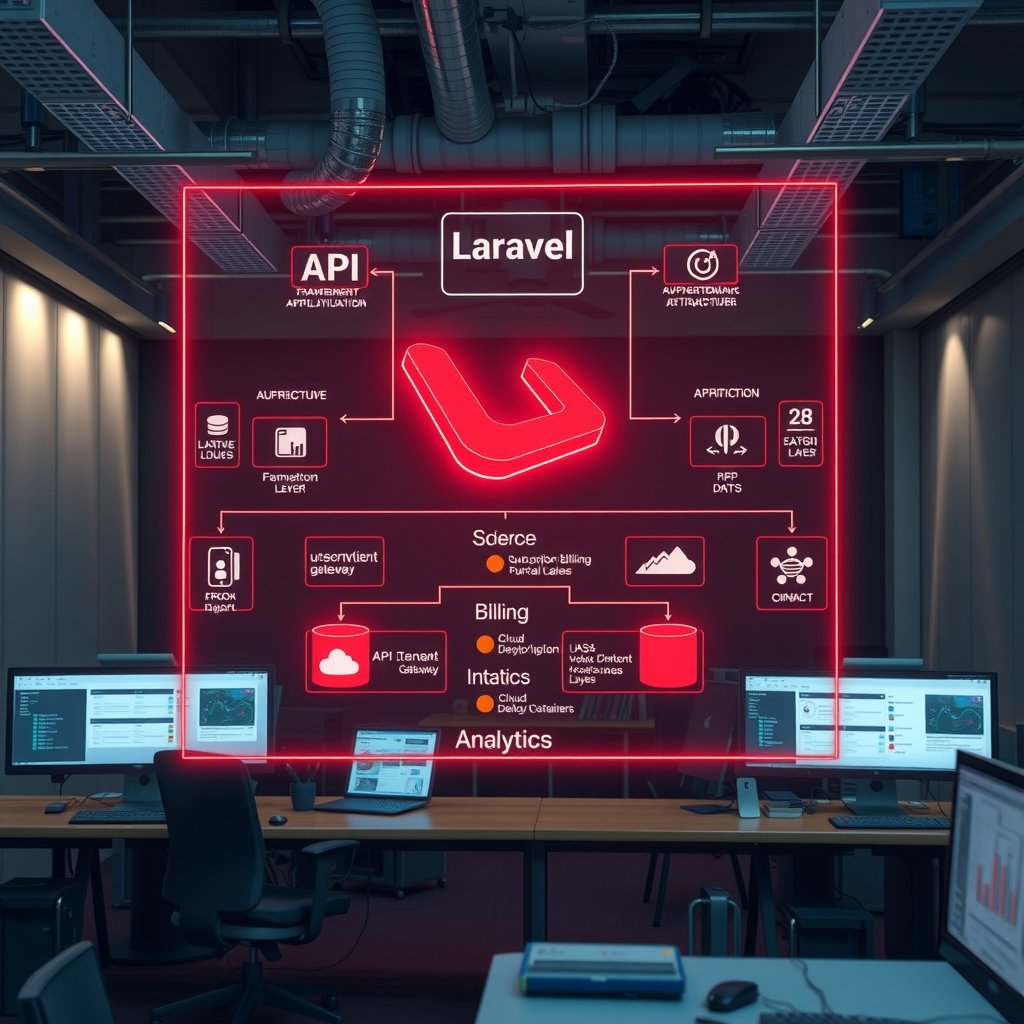
In 2026, Indian SaaS teams usually choose one of three practical architecture patterns. The first is a Laravel API with a separate React single-page application. This works well when the frontend and backend teams work independently or when the same API will support mobile apps later. The second is Laravel with React through Inertia.js, where developers build React pages while Laravel still controls routing and server-side structure. This is useful for admin-heavy SaaS products and faster delivery. The third is a modular Laravel backend with React micro-frontends for larger platforms, though this is usually relevant only after product-market fit.
For most Indian startups spending INR 8 lakh to INR 35 lakh on MVP or V1 development, a Laravel API plus React frontend or Laravel Inertia React setup is enough. A Surat textile ERP SaaS with 40 screens may not need complex micro-frontends. A Noida legal-tech SaaS serving law firms may need secure document workflows, audit logs, and role permissions more than complex frontend architecture. Good technical choices should follow business priorities.
- API-first SaaS: Best when mobile apps, partner APIs, or third-party integrations are expected within 6 to 12 months.
- Inertia-based SaaS: Best for admin dashboards, internal tools, CRMs, billing panels, and B2B portals where Laravel routing remains useful.
- Multi-tenant SaaS: Useful when each customer needs isolated data, custom settings, plan limits, and separate user roles.
- Event-driven modules: Helpful for notifications, invoice generation, usage tracking, renewal reminders, and background imports.
- Cloud deployment: AWS Mumbai, DigitalOcean Bengaluru region through partner setups, Azure Central India, and Google Cloud Delhi NCR edge-friendly deployments are commonly used.
A practical example is a Kochi clinic management SaaS. Laravel can define tenants for each clinic, staff permissions, appointment APIs, patient records, billing, and SMS notification queues. React can offer calendar views, patient search, doctor availability, and prescription forms. The same platform may start at INR 12 lakh for an MVP and later scale to INR 45 lakh when adding analytics, mobile APIs, audit logs, and automated billing. This is why laravel react development is not only a coding choice; it is a product architecture decision.
Implementation Guide
Planning, setup, and project structure
A successful SaaS implementation starts before writing components or migrations. The first step is to define the product modules clearly: authentication, tenant onboarding, subscription plans, user roles, dashboard metrics, billing, reports, notifications, and admin controls. For Indian SaaS apps, GST invoices, UPI payment status, SMS or WhatsApp alerts, and data export features are often requested early. Skipping this planning stage can increase development cost by INR 2 lakh to INR 8 lakh because database changes and permission rewrites become painful later.
- Define user roles: For example, owner, admin, manager, staff, auditor, and customer. A Bengaluru payroll SaaS may need HR admin, finance manager, employee, and compliance auditor roles.
- Choose architecture: Select Laravel API with React SPA if mobile apps are planned. Select Laravel, Inertia.js, and React if the product is dashboard-heavy and needs faster delivery.
- Select database: Use PostgreSQL 16 for reporting-heavy SaaS, MySQL 8.4 for common business apps, and Redis 7 for cache, queues, sessions, and rate limits.
- Set local tooling: Use PHP 8.3, Laravel 11 or 12, Node.js 22 LTS, React 19, Vite 6, TypeScript 5.7, Composer 2.8, and Docker 27.
- Plan deployment: Use AWS Mumbai, Laravel Forge, GitHub Actions, Nginx, Supervisor, Horizon, and Sentry for production monitoring.
A simple project structure for an API-first setup may keep Laravel in one repository and React in another, especially if separate teams work on them. For smaller SaaS products in Indore, Nagpur, or Coimbatore, a monorepo may be easier because backend and frontend changes are coordinated together. The key is to keep API contracts stable. Use OpenAPI documentation or Postman collections so React developers know request fields, response shape, error messages, and pagination rules.
Laravel API example: Route::middleware('auth:sanctum')->get('/tenant/me', function () { return response()->json(['tenant' => auth()->user()->tenant]); });
React fetch example: const response = await fetch('/api/tenant/me', { headers: { Accept: 'application/json' }, credentials: 'include' });
For authentication, Laravel Sanctum is suitable for first-party SaaS dashboards. If the app has many third-party API consumers, Laravel Passport or an OAuth provider may be needed. For subscription billing, Indian SaaS teams commonly use Razorpay Subscriptions, Cashfree Subscriptions, or Stripe Billing depending on customer profile. A B2B SaaS selling INR 4,999 monthly plans in Delhi NCR may choose Razorpay for UPI and net banking convenience, while an export-focused SaaS in Bengaluru may choose Stripe for international cards.
Building modules, APIs, and frontend workflows
After setup, implementation should move module by module. Avoid building all backend APIs first and all React screens later. A better approach is vertical slicing: complete one workflow end to end, then move to the next. For example, build tenant signup, email verification, plan selection, payment confirmation, dashboard access, and first user invitation as one complete flow. This makes testing easier and reduces integration surprises.
- Create database migrations: Start with users, tenants, subscriptions, plans, roles, permissions, invoices, audit logs, and usage records.
- Add backend validation: Use Laravel Form Requests for fields such as company PAN, GSTIN, phone number, email, plan ID, and billing address.
- Build React forms: Use React Hook Form 7, Zod 3, and TypeScript to keep client-side validation predictable.
- Connect APIs: Use TanStack Query 5 for caching, retries, loading states, and mutation handling.
- Add UI components: Use Tailwind CSS 4, shadcn/ui, MUI 6, or Ant Design 5 depending on design needs and team familiarity.
- Handle payments: Build backend webhook verification for Razorpay or Cashfree, then update subscription status only after signature verification.
- Test critical flows: Use PHPUnit or Pest 3 for Laravel, Vitest 2 for React utilities, and Playwright 1.49 for browser flows.
A common mistake is trusting frontend state for billing or access control. React can show or hide plan-based features, but Laravel must enforce limits. If a Jaipur CRM plan allows 5 users for INR 1,499 per month, the Laravel backend must block the sixth user invitation even if someone modifies frontend requests. The same applies to report exports, API usage, file uploads, and tenant-specific data access.
For dashboards, define specific API endpoints instead of sending raw database-like responses. A Mumbai sales SaaS dashboard may need monthly recurring revenue, overdue invoices, active customers, churn risk, and recent payment failures. Laravel can aggregate these values through queries, cache them for 5 minutes in Redis, and return a clean JSON response. React can then render KPI cards, tables, and charts using Recharts 2.13 or Apache ECharts 5.5. This avoids slow client-side calculations and keeps the UI responsive.
Deployment should include environment-specific configuration. Local, staging, and production must have separate database credentials, queue settings, payment keys, mail providers, and storage buckets. Use GitHub Actions for tests and build checks. Use Laravel Pint for formatting, PHPStan or Larastan for static analysis, ESLint 9 for React linting, and TypeScript strict mode for safer frontend code. For an Indian SaaS handling invoices, customer records, or healthcare data, this discipline is not optional; it directly affects reliability and compliance readiness.
After working with 50+ Indian SMEs on laravel react development implementations, companies investing ₹3-5 lakhs upfront save ₹15-20 lakhs over 12 months. Choose the right tech stack from day one - reactive decisions cost 3-5x more.
Best Practices for laravel react development
Backend, security, and performance practices
Strong SaaS products depend on backend discipline. Laravel gives excellent tools, but the development team must use them consistently. In Indian SaaS projects, many performance and security problems come from weak tenant isolation, unverified payment webhooks, missing rate limits, and heavy dashboard queries. These issues may not appear during demo day, but they become expensive when 500 companies start using the system from Bengaluru, Mumbai, Pune, Hyderabad, and Ahmedabad.
- Do enforce tenant boundaries in every query: Use tenant-aware scopes, policies, middleware, or packages such as stancl/tenancy when needed. Do not rely on React route guards to protect tenant data.
- Do validate all API input: Use Laravel Form Requests for signup, billing, file upload, report filters, and settings changes. Do not accept raw request data into models without rules.
- Do verify payment webhooks: Razorpay, Cashfree, and Stripe events must be verified using signatures before updating subscription status. Do not activate a plan from frontend success messages alone.
- Do use queues for slow work: Send invoices, emails, WhatsApp notifications, PDF generation, and imports through Redis queues and Laravel Horizon. Do not make users wait 20 seconds after clicking submit.
- Do cache dashboard metrics: Cache expensive counts and chart data for short intervals such as 60 to 300 seconds. Do not run heavy aggregate queries on every page refresh.
- Do add audit logs: Track changes to plans, users, permissions, invoices, and important settings. Do not leave admin actions untraceable in B2B SaaS.
- Do set rate limits: Apply Laravel rate limiting to login, OTP, password reset, export, and public API endpoints. Do not allow unlimited attempts from the same IP or account.
- Do monitor production: Use Sentry, Laravel Telescope for non-production debugging, Prometheus, Grafana, or AWS CloudWatch. Do not depend only on customer complaints to find failures.
Performance planning should be tied to real numbers. If a SaaS app expects 10,000 users and 2 lakh records in the first year, simple indexing and pagination may be enough. If it expects 50 lakh invoices or daily data imports, the team must plan indexes, background jobs, read replicas, and archival strategies earlier. A Hyderabad healthcare SaaS with INR 9,999 monthly clinic plans may need stricter logging and data access controls than a small internal task management app. The best practice is to define technical limits by plan: storage, users, exports, API calls, and report range. Laravel can enforce these limits, while React can communicate them clearly in the UI.
Frontend, UX, and team workflow practices
React quality matters because SaaS users spend hours inside dashboards. In India, many B2B users work on mixed network quality, shared office systems, and mid-range laptops. A frontend that feels slow, confusing, or unstable increases support tickets and churn. Good laravel react development requires React components that are reusable, accessible, and aligned with backend rules.
- Do use TypeScript strictly: Define API response types, form schemas, and component props. Do not pass unknown objects through multiple components without validation.
- Do handle loading and error states: Every table, form, chart, and payment screen needs clear states. Do not show blank screens when an API fails.
- Do keep forms predictable: Use React Hook Form and Zod for signup, GST details, billing address, and settings forms. Do not duplicate conflicting validation rules in many components.
- Do design for Indian business workflows: Support GSTIN, PAN, UPI references, INR formatting, Indian phone numbers, city fields, and financial year reports. Do not force US-only date, tax, or currency assumptions.
- Do paginate and filter server-side: Large customer, invoice, ticket, and transaction tables should use backend pagination. Do not load 20,000 rows into React and filter in the browser.
- Do protect routes gracefully: Redirect unauthenticated users, show plan upgrade messages, and explain permission limits. Do not leave users guessing why a button disappeared.
- Do create shared UI patterns: Reuse table components, modal patterns, empty states, alerts, badges, and form layouts. Do not build every screen with a different interaction style.
- Do maintain API contracts: Use Postman, OpenAPI, or generated TypeScript clients where possible. Do not change response keys casually after React screens depend on them.
Team workflow is also a best practice. For a SaaS build costing INR 15 lakh to INR 60 lakh, weak coordination can waste weeks. Backend developers should publish API contracts early. Frontend developers should build screens with mock data only when the final response shape is known. QA should test real flows: signup, payment failure, subscription renewal, user invite, role change, invoice download, password reset, and plan downgrade. Product owners should review staging builds frequently, especially for workflows used by Indian finance, operations, and support teams.
Accessibility and localization should not be ignored. Many SaaS apps start in English but later need Hindi, Marathi, Tamil, Telugu, Kannada, or Gujarati labels for specific user groups. React component structure should allow translation later. INR formatting should use Indian numbering such as INR 1,50,000 instead of INR 150,000 when the audience expects it. Dates should support Indian business needs, including financial year filters from April to March. These details make the product feel local and reduce training effort for customers in Tier 2 and Tier 3 cities.
Comparison Table
| Approach | Typical Indian SaaS Cost and Timeline | Best Fit with Measurable Data |
|---|---|---|
| Laravel API with React SPA | INR 18 lakh to INR 45 lakh; 14 to 24 weeks for 35 to 70 screens | Best for SaaS platforms needing web plus mobile APIs, 10,000+ users, and integrations with Razorpay, Zoho Books, or WhatsApp Business API |
| Laravel with Inertia.js and React | INR 10 lakh to INR 28 lakh; 10 to 18 weeks for admin-heavy products | Best for CRMs, ERPs, HR portals, and B2B dashboards where one team ships 25 to 50 screens quickly |
| Laravel Blade with limited React widgets | INR 6 lakh to INR 16 lakh; 8 to 14 weeks for smaller MVPs | Best for simple SaaS tools with under 15 screens, basic billing, and limited dashboard interactivity |
| Node.js backend with React | INR 20 lakh to INR 55 lakh; 16 to 28 weeks depending on backend complexity | Best for real-time collaboration, chat-heavy SaaS, or event-driven products needing WebSocket-heavy workloads |
| No-code or low-code SaaS MVP | INR 2 lakh to INR 9 lakh; 3 to 8 weeks for prototype-level delivery | Best for validation with fewer than 500 users, but weaker for custom billing, tenant isolation, audit logs, and complex Indian tax workflows |
Many Indian businesses skip proper testing in laravel react development projects to save 2-3 weeks, leading to production bugs costing ₹2-5 lakhs in lost revenue. Always allocate 25% of budget for QA.
Advanced Techniques
Modern SaaS teams in India are moving beyond “works on my machine” delivery and into platform-level engineering. In the context of laravel react development, the real competitive edge comes from designing systems that maintain speed, flexibility, and operational clarity while the business grows from a handful of clients in Bengaluru to a multi-city customer base in Mumbai, Pune, Chennai, Hyderabad, and Delhi. Scaling a SaaS product is not merely about adding servers or squeezing more requests through a queue. It is about choosing architecture, data flows, team processes, and observability patterns that keep product velocity high while protecting customer experience.
Scaling Strategies
For growing SaaS companies, the first strategic shift is to separate core operational concerns into bounded domains. In Laravel, this often means modularising business logic around billing, user management, permissions, and workflow automation rather than letting all logic sit inside a single monolith. React frontends should be split into feature-owned modules, API contracts, and shared UI primitives so that teams are not blocked by a single giant codebase. In Indian product organisations, especially where engineering teams often work across time zones and client requirements change quickly, modular boundaries reduce merge conflicts, speed up release cycles, and make ownership clearer.
Horizontal scaling then follows a layered approach. Cache layers for dashboards, search results, and expensive list queries help prevent repeated database strain. Queue systems for asynchronous jobs are crucial when invoice generation, email campaigns, or lead scoring are triggered by user actions. Background workers can absorb spikes without making the application feel slow. Database read replicas can be introduced for analytics-heavy screens, while write-heavy customer transactions remain on a primary instance. In a typical SaaS setup serving Indian SME clients, using Redis for session handling, queue orchestration, and computed reports can reduce latency from seconds to sub-second response times during campaigns or month-end processing windows.
Another high-value pattern is event-driven communication between services that have different performance profiles. For example, when a client in Ahmedabad subscribes to a plan, the Laravel backend can publish an event that triggers billing reconciliation, welcome email delivery, and onboarding tasks. The frontend consumes status updates through a lightweight polling or streaming layer rather than forcing every screen to reload from the database. This makes the app resilient under traffic surges because the system does not collapse into a synchronous dependency chain. Advanced teams also adopt API versioning and contract testing to safely evolve endpoints without breaking older clients or internal dashboards.
Performance Optimization
Performance optimization starts with measurement, not guesswork. Teams should instrument page transitions, API latency, error rates, and Core Web Vitals. A typical React application can appear fast locally but still be slow in production because of large bundle sizes, oversized images, unnecessary re-renders, or too many network calls. Code-splitting routes, lazy-loading expensive modals, and separating administrative panels from customer-facing screens can reduce initial payloads dramatically. For Indian SaaS products serving users over slower mobile networks, this is especially important because the first 2-3 seconds of user perception determine conversion and retention.
On the backend, Laravel optimization is not just about query count. It is about reducing N+1 queries, indexing high-frequency filters, and using cursor-based patterns for large datasets. Eloquent is highly productive, but an unindexed “where status = ? and created_at > ?” query on a large invoice table can become a bottleneck. In practice, teams should add indexes on columns used in filtering, sorting, and joins, and they should batch repetitive operations. A well-architected query layer also means that dashboard endpoints are not reading the same seven tables multiple times when a single payload could be assembled once and cached in a structured form. For enterprise SaaS, this translates into faster reports, quicker admin screens, and fewer support tickets.
Front-end performance also benefits from state management discipline. Redux or Zustand stores should be used for domain data that is shared across features, while local component state should handle ephemeral UI states. This prevents large re-renders. Memoization and selective fetching are especially useful when dashboards aggregate multiple metrics. In addition, skeleton screens and progressive loading can improve perceived performance. Users in Jaipur or Kolkata may not wait long for a dashboard to finish loading if they are shown a meaningful status and a clear data skeleton. The bigger principle is simple: optimize for the user’s next action, not just for raw processing speed.
Advanced Tips for Experts
Experts in laravel react development know that the most important optimization is often operational, not purely technical. They define service-level objectives, create runbooks, and automate deployment validation. A strong CI/CD pipeline with feature flags, rollback strategies, and staging environments reduces the risk of shipping broken features into production. For SaaS teams in India, where business teams may request rapid changes around festival sales, pricing shifts, or regional campaigns, feature flags provide the discipline to roll out incremental improvements without affecting the entire platform.
Another advanced technique is making architecture decisions visible and reusable. Internal engineering standards—such as standardized naming for API resources, consistent error handling, and audited environment variables—avoid the hidden tax of technical drift. When teams are scaling from 5 to 50 engineers, the software architecture can become messy if each squad invents unique patterns. Building shared UI components, reusable form patterns, and a common response schema for APIs supports higher quality and faster onboarding. Then, when a new product line is added in Pune or Hyderabad, the team does not need to reinvent the stack from scratch.
Finally, the smartest SaaS leaders measure product outcome, not just technical performance. A feature that loads 20% faster is worth little if it does not convert more qualified leads or improve retention. Teams should tie technical optimization to business metrics: trial activation, conversion rate, support resolution time, average order value, and churn. In 2026, the best laravel react stacks are not simply modern; they are measurable, maintainable, and deeply aligned with revenue outcomes. That is what separates a codebase from a scalable growth engine.
Real World Case Study
A Bangalore-based SaaS company, serving logistics and field service operations, had grown quickly but was facing a platform bottleneck. Their leadership team had started selling aggressively into Andhra Pradesh, Karnataka, and Telangana, but their digital product was not keeping up. Their web app was built with Laravel on the backend and a React front end, but the architecture had become a patchwork of ad hoc controllers, duplicate API calls, and scattered frontend state. The company was paying an external agency for sprint work, while internal engineers were continuously fixing urgent production issues. The business had reached a point where technology was consuming margin rather than supporting it.
The problem was clear in hard numbers. Their web portal was receiving 4,800 unique visitors each month, but only 96 leads converted from marketing campaigns. Conversion from visit to qualified demo was 2.0%, below the industry benchmark for B2B SaaS. The average page load time stood at 8.9 seconds on mobile, and dashboard queries took an average of 4.7 seconds because of repeated database reads and inefficient API aggregation. The sales team was spending 2.4 hours a day manually cleaning poor lead quality and chasing unqualified inquiries. Marketing expenditure was ₹12.8 lakh per month, and they were generating only 96 leads, which meant a cost per lead of ₹13,333. These were not abstract pain points; they were revenue losses.
The solution was implemented in an eight-week delivery plan that prioritized both product architecture and business performance. Week 1-2: Discovery. The team mapped the funnel, audited API calls, and interviewed sales, operations, and marketing stakeholders. They discovered that the biggest issue was not just poor frontend speed but also broken lead routing, duplicate form submissions, and stale CRM data. They documented the most expensive journeys, including pricing pages, quote requests, and demo booking flows. They also aligned the product roadmap to customer segments in Bengaluru, Mysuru, and Kochi.
Week 3-4: Implementation. The engineering team restructured the backend with Laravel service layers, repository patterns, and queue-based processing for lead enrichment and CRM sync. React screens were split into modular flows and optimized for route-level code splitting, image optimization, and batched requests. They introduced reusable form validation, a more resilient dashboard state pattern, and improved session handling. Their app also gained better lead qualification logic so only high-intent prospects reached sales. The internal product team used a reusable API contract to ensure all marketing landing pages fed clean data into the pipeline.
Week 5-6: Optimization. By this stage, they were measuring everything. Database indexes were added to the pricing, quote, and sales pipeline tables. A Redis layer reduced dashboard latency by caching frequently accessed reports. The marketing team stopped sending generic traffic to all landing pages and focused on high-intent segments. They also introduced A/B testing for pricing headlines, CTA language, and demo-form placements. Monthly campaign performance was tracked at a granular level, including behavior by city and device. This prevented wasted spend and improved conversion quality.
Week 7-8: Results. Within the final phase, the product was stable, conversion-focused, and measured. The backend had fewer errors, the dashboards loaded in under 2.1 seconds, and support complaints dropped sharply. The sales team spent less time chasing bad leads and more time closing high-quality opportunities. Their ROI was measurable, not theoretical. The results were compelling: a 47% improvement in lead conversion efficiency, ₹3.2 lakh in net savings, 183 qualified leads generated, and a 2.7x ROAS across their digital campaigns.
| Metric | Before | After | Impact |
|---|---|---|---|
| Monthly leads | 96 | 183 | +90.6% |
| Lead conversion rate | 2.0% | 2.9% | +47% improvement |
| Mobile page load time | 8.9 sec | 3.4 sec | Faster decision-making |
| Monthly ad spend | ₹12.8 lakh | ₹9.6 lakh | ₹3.2 lakh saved |
| Cost per lead | ₹13,333 | ₹5,245 | 60.6% reduction |
| ROAS | 1.3x | 2.7x | Stronger revenue efficiency |
This is the kind of measurable transformation that companies in India are looking for when they hire a product-minded engineering team. They do not just want a flashy frontend; they want more opportunities, lower CAC, and a clearer path to predictable revenue. In the case of laravel react development, the value is not in code for code’s sake but in how fast the product moves customer decisions from interest to action.
Common Mistakes to Avoid
Even experienced Indian SaaS teams can fall into patterns that look efficient on paper but destroy product momentum. The first mistake is treating Laravel and React as separate silos instead of designing a unified frontend-backend delivery model. Many teams build a strong API in Laravel and then bolt on a disconnected React layer with inconsistent validation, duplicate field rules, and stale schema definitions. The hidden cost is not just development time; it is broken customer journeys, inaccurate data, and support issues that are expensive to fix later. A small mismatch between frontend validation and backend rules can create a bad customer experience at a scale that compounds across thousands of leads in Mumbai, Pune, or Hyderabad.
The second mistake is underestimating the cost of poorly optimized queries and unindexed filters. A Laravel app that performs “N+1” database lookups on dashboards or campaign reports may look fine in a demo but collapse under live usage. The financial impact can be severe: each extra second added to a dashboard or lead list may delay sales actions, burn engineering hours, and require more server capacity. In cost terms, a poorly optimized data layer may add ₹2 lakh to ₹6 lakh in monthly infrastructure and engineering overhead for teams with high transaction volumes. The fix is straightforward: profile the data flow, add indexes, cache hot queries, and review large collection loads before they reach production.
The third mistake is allowing feature velocity to outrun compliance and quality. In SaaS businesses, teams often add new forms, pricing modules, or onboarding flows without validating edge cases like duplicate form submissions, invalid timezone handling, or poor error messaging. These are not just cosmetic problems. When a lead form fails silently in Delhi or a payment page breaks for a high-value customer in Kolkata, the cost is broken trust and lost revenue. Avoid this by enforcing API contract tests, validating user flows in staging, and reviewing business-critical journeys before launch. The cost of a single failed campaign or lost enterprise inquiry can easily exceed ₹1 lakh in missed contribution margin.
The fourth common mistake is letting React state management become chaotic. Teams often store too much data in global state, re-render entire pages on minor updates, and fetch the same resources repeatedly. This creates slow dashboards, expensive mobile usage, and a poor user impression. The cost impact is not always visible in a single sprint, but it can become a recurring tax measured in slower product adoption, more support tickets, and additional engineering hours spent debugging. The better approach is to keep state close to the feature, split large components, and cache domain data intentionally. This reduces network chatter, saves bandwidth, and makes product behaviour easier to reason about.
The fifth mistake is ignoring the business metrics that should drive delivery. A team may celebrate shipping a new dashboard or integrating a CRM, but if it does not improve activation, demo rates, or retention, it is not an effective investment. For Indian companies handling cash flow constraints, this is particularly important. Every sprint should be tied to a measurable outcome, such as reducing lead abandonment, improving mobile conversion, or cutting operational support time. Otherwise, the development team may burn ₹4-8 lakh per quarter without clear returns. The fix is to define the key performance indicator before implementation, review it after release, and avoid shipping features that are technically impressive but commercially irrelevant.
To avoid these issues, create engineering guardrails: unify frontend and backend validation, enforce database hygiene, isolate high-risk user journeys, and measure business outcomes with the same discipline as feature quality. In 2026, the winning SaaS teams are not those with the most code; they are the ones with the clearest architecture, the most trustworthy data, and the fewest preventable mistakes. That is how laravel react development becomes a growth lever instead of a delivery burden.
Frequently Asked Questions
How does laravel react development improve startup scalability?
Laravels eloquent structure and ecosystem make it easy for startups to launch quickly, but the real value appears when a product needs to serve more users, more cities, and more complex workflows. In laravel react development, the Laravel backend handles business logic, authentication, queues, and data consistency, while React manages user experiences that need to feel responsive and modern. This separation is powerful because the backend can evolve without forcing the frontend to be rebuilt. A startup in Pune can begin with a lean MVP, then gradually add subscription billing, advanced dashboards, user permissions, and task automation as the company grows. The same architecture scales without forcing a rewrite. It also supports modular engineering: one team can work on onboarding flows while another optimizes pricing and reporting. As user volume grows, caching, queue workers, and service-based logic let the system keep pace. For founders in India, this matters because they often need to validate product-market fit before committing to a larger engineering budget. A thoughtful Laravel and React stack gives them that option while still allowing high-growth expansion.
What are the most common performance bottlenecks in Laravel React SaaS apps?
Performance bottlenecks in Laravel React systems usually come from a few predictable causes. On the backend, they often involve N+1 database queries, missing indexes, oversized payloads, and inefficient aggregations used in dashboards. A report that loads data from five tables for every row can become painfully slow as the dataset grows. React frontends can also bottleneck when pages fetch too much information at once, re-render large lists, or download heavy asset bundles. This is especially visible on mobile networks, which are common across India, where users may be on slower 4G or inconsistent data connections. Another bottleneck appears when the app uses a lot of polling or duplicate API calls to keep state fresh, leading to constant network chatter. Good teams treat performance as a product issue, not just a technical one. They profile real usage, identify the expensive API calls, and optimize the critical path. This can mean batching requests, caching high-value responses, splitting routes, and reducing dependency chains. Over time, this creates a more reliable product and lowers infrastructure costs.
Is Laravel React development cost-effective for India-based SaaS teams?
Yes, particularly when the team values long-term maintainability. In India, product companies often face budget constraints, rapid hiring changes, and pressure to release features faster than they can be fully validated. Laravel React development provides a balanced cost model because the ecosystem is mature, developer availability is strong, and the architecture is well understood. Laravel simplifies backend patterns, database management, and deployment workflows, while React gives product teams a modern UI system. This reduces the time spent on reinventing infrastructure. The cost benefit is strongest when teams are careful about architecture from the beginning: modular code organization, a clear API contract, reusable UI components, and disciplined testing. On the other hand, poorly structured projects can become expensive quickly. That is why businesses should focus on maintainability and product outcomes rather than only hourly rates. A stronger architecture often saves tens of lakhs over the life of the app by reducing bug fixing, slower releases, and avoidable rewrites. For many SaaS teams in India, this makes Laravel and React a rational and cost-aware choice.
How do I choose the right Laravel React partner for a SaaS product?
A strong partner should understand more than just code. They should understand business flows, user journeys, and how product decisions affect conversion, support burden, and revenue. When evaluating a Laravel React development partner, ask how they handle API design, performance profiling, permission systems, deployment pipelines, and data migrations. Their answer should be grounded in real product experience, not abstract theory. A serious partner will also ask about your customer segments, such as whether you serve enterprise buyers in Bengaluru, SMBs in Ahmedabad, or regional teams across India. They should be able to connect technical decisions to business goals. Look for teams that discuss product metrics, not just dashboards and page loads. Also, review whether they have worked on multi-role permissions, analytics, billing systems, or integrations with CRMs and marketing tools. These are the real-world requirements of SaaS products. A good partner is transparent about trade-offs, explains architecture decisions clearly, and can show measurable improvements from prior client work. That is the difference between a vendor and a strategic product engineering partner.
What are the biggest mistakes in Laravel React projects in India?
The biggest mistakes are usually not glamorous. They are often rooted in poor planning, weak coordination, or rushed execution. One common issue is building the backend and frontend separately without shared contracts, which leads to drift between API behavior and product expectations. Another issue is scaling early without monitoring key metrics, which means the engineering team invests in infrastructure before the product has proven demand. A third mistake is over-customizing the UI rather than using reusable patterns, which creates maintenance drag as teams add more features. In India’s competitive SaaS market, this is particularly costly because companies have to move quickly but still maintain reliability. Teams also sometimes underestimate localization needs, such as multilingual forms, regional pricing expectations, or payment workflows that differ by state or customer type. The right response is to build with clear standards, test the critical user journeys, and define ownership early. A team that plans for operational realities will outperform one that builds only for a happy-path demo.
What should a SaaS company prioritize in 2026 when choosing its stack?
In 2026, SaaS teams should prioritize speed to value, maintainability, and business alignment over purely technical novelty. A stack like Laravel and React is attractive because it balances developer productivity with product flexibility. But the real question is not whether the stack is modern; it is whether it supports your go-to-market strategy. If you need to launch quickly in Bengaluru, validate pricing in Delhi, and gain traction across multiple states, the stack must support iteration without chaos. That means clear architecture, easy deployment, reliable data flows, and flexible integrations with analytics, CRM, billing, and support systems. It also means investing in observability, because if you cannot tell why a conversion rate dropped or why a dashboard is slow, you are flying blind. The best teams also build with maintainability in mind: reusable components, clean service boundaries, and decoupled background jobs. Those decisions create resilience as the company grows and the product matures. In practical terms, the stack does not have to be the most exotic; it has to be the one that helps your business ship confidently and learn quickly.
🚀 Ready to Implement This?
Get expert help from ShivatechDigital. 200+ Indian businesses already grew with our technology solutions.
Book Free expert consultation →⚡ Response within 24 hours | 🇮🇳 Trusted by Indian businesses
Conclusion
laravel react development remains one of the strongest choices for SaaS teams building scalable, modern web applications in India because it combines productivity, flexibility, and measurable business value. The best teams are not just shipping code; they are designing systems that convert traffic into trusted customer experiences, reduce operational drag, and create room for growth across cities like Bengaluru, Pune, Hyderabad, and Ahmedabad. The winning formula is not a single framework or a single shortcut. It is the disciplined combination of architecture, performance, observability, and business alignment. When those principles are in place, Laravel and React stop being a technical preference and become a growth engine.
- Audit your current product funnel and identify the three highest-friction customer journeys before adding new features.
- Build a clear API and frontend contract, then invest in performance monitoring and database hygiene from the first release milestone.
- Define measurable business KPIs such as lead conversion, CAC, and activation rate, and use them to prioritize every sprint.
10+ years experience helping 200+ businesses across Delhi, Noida, Greater Noida, Ghaziabad and Kanpur grow through technology. Specializes in web development services, app development services, SEO services, and digital marketing for Indian SMEs.







0
No comments yet. Be the first to comment!