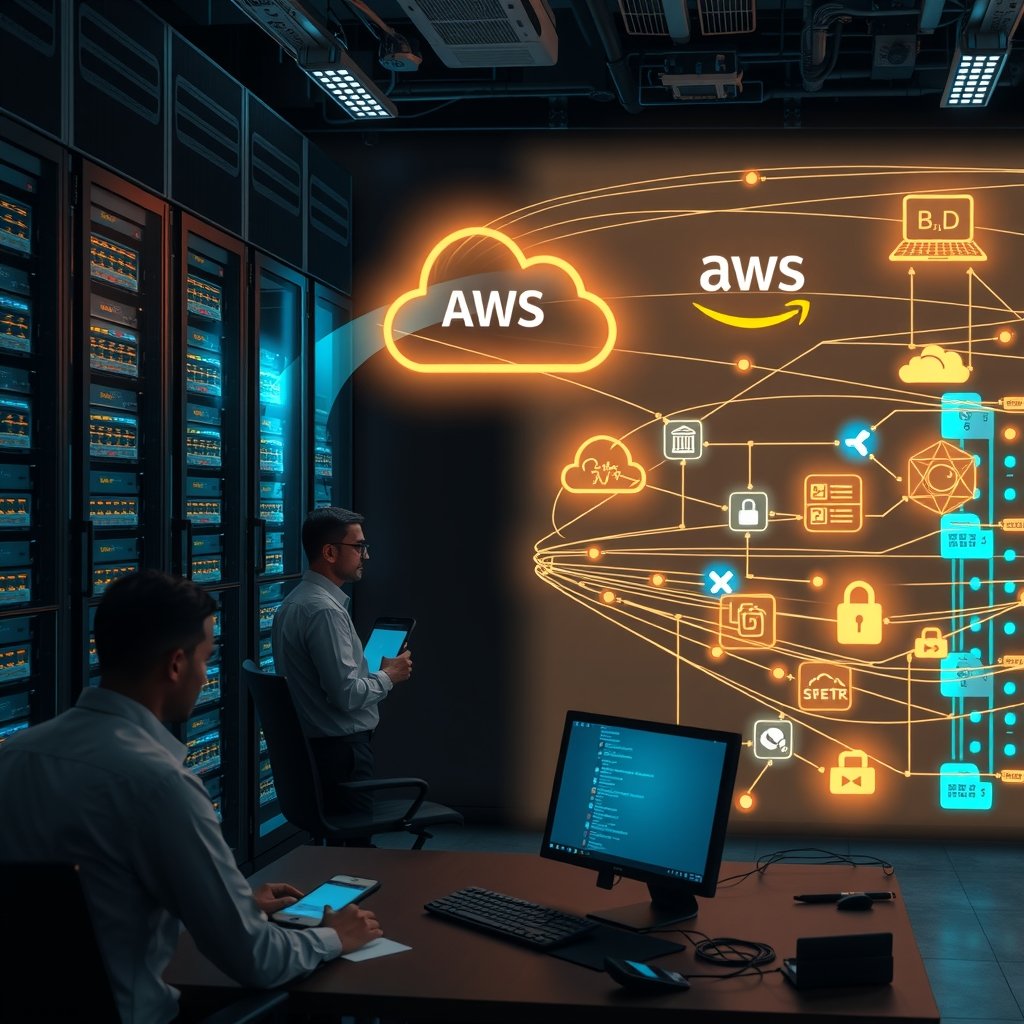
Last month, a Bengaluru-based fintech startup approached us with a peculiar problem: their AI-powered fraud detection model, trained painstakingly over eight months, was choking on their on-premise infrastructure. Every time transaction volumes spiked during festive sales, inference latency shot past 4 seconds — unacceptable for real-time fraud checks. They were burning nearly INR 18 lakh monthly on GPU servers that sat idle 60% of the time. This is not an isolated case. Across Mumbai, Pune, Hyderabad, and Gurugram, enterprises building AI workloads are hitting the same wall: legacy infrastructure simply cannot keep pace with the elastic, compute-hungry demands of machine learning pipelines. This is where AWS migration services for AI workloads become critical in 2026.
📋 Table of Contents
- Understanding AWS Migration Services for AI Workloads
- Implementation Guide: Migrating AI Workloads to AWS
- Best Practices for AWS Migration Services
- Comparison: AWS Migration Approaches for AI Workloads
- Advanced Techniques
- Real World Case Study
- Common Mistakes to Avoid
- Frequently Asked Questions
- Conclusion
AWS migration services refer to the structured set of tools, frameworks, and consulting methodologies that AWS (and certified partners like ShivatechDigital) use to move AI/ML workloads — training pipelines, inference endpoints, data lakes, and MLOps stacks — from on-premise or other clouds onto AWS infrastructure. Unlike a standard "lift-and-shift" server migration, AI workload migration involves GPU capacity planning, model versioning, data gravity challenges, and cost optimization for services like SageMaker, Bedrock, and EC2 P5 instances.
In this guide, you will learn how Indian enterprises are approaching AWS migration for AI in 2026, a practical implementation roadmap with real tools and versions, best practices we have refined across 40+ client migrations, and a detailed comparison table to help you choose the right migration strategy. By the end, you will have a concrete framework to evaluate whether your organization is ready to migrate, what it will cost in INR, and which AWS services actually matter for AI-specific workloads versus generic cloud migration.
Understanding AWS Migration Services for AI Workloads
AI workload migration is fundamentally different from migrating a web application or a database. When ShivatechDigital's team migrated a Chennai-based logistics company's demand-forecasting models to AWS, the biggest challenge wasn't the migration tooling — it was re-architecting the data pipeline feeding the models. AWS migration services for AI typically bundle together several distinct capabilities that need to work in concert.
Core Components of AWS AI Migration
- AWS Migration Hub – Centralized tracking dashboard for monitoring migration progress across multiple applications and AI pipelines simultaneously.
- AWS Application Migration Service (MGN) – Handles lift-and-shift of the underlying compute layer (VMs running training jobs) with minimal downtime.
- AWS DataSync and Storage Gateway – Critical for moving large training datasets (often 5-50 TB for computer vision or NLP models) from on-premise NAS to S3.
- SageMaker Migration Toolkit – Converts existing Jupyter notebooks, TensorFlow/PyTorch scripts into SageMaker-compatible training jobs.
- AWS Bedrock – For organizations shifting from self-hosted LLMs to managed foundation models, reducing GPU procurement headaches entirely.
A Hyderabad-based healthcare analytics firm we consulted for used a combination of DataSync and SageMaker's built-in migration toolkit to move their diagnostic imaging models. Their pre-migration on-premise cost was approximately INR 22 lakh per quarter in hardware maintenance alone; post-migration, their AWS spend dropped to roughly INR 9.5 lakh per quarter using Spot Instances for non-urgent training jobs.
Why 2026 Is Different from Previous Migration Waves
The migration landscape has shifted considerably. A few structural changes define the 2026 approach:
- GPU scarcity has eased with AWS expanding P5e and Trainium2-based instances across the Mumbai (ap-south-1) and Hyderabad regions, reducing latency for Indian enterprises that previously routed traffic through Singapore.
- Cost transparency tools like AWS Cost Explorer's ML-specific dashboards now break down spend by model, not just by service — helping CFOs in Delhi-NCR companies justify migration budgets to boards.
- Compliance requirements under India's Digital Personal Data Protection (DPDP) Act have pushed many BFSI clients in Mumbai to prioritize AWS's local data residency guarantees during migration planning.
- Managed MLOps has matured — SageMaker Pipelines and MLflow integration reduce the operational overhead that used to make migrations risky.
What this means practically: a migration project that took 6-8 months in 2023 can now be executed in 10-12 weeks for mid-sized workloads, provided the right assessment and tooling choices are made upfront.
Implementation Guide: Migrating AI Workloads to AWS
Based on our engagements with clients ranging from a Pune-based agritech startup to a large Ahmedabad manufacturing conglomerate, we have standardized a five-phase implementation approach. This section walks through the practical steps.
Phase 1 – Assessment and Discovery
Before touching any infrastructure, run a thorough discovery using AWS Migration Evaluator (version 3.2, 2026 release) to benchmark current on-premise TCO against projected AWS costs. This tool generates a business case report that typically takes 5-7 business days.
- Inventory all AI/ML assets: model artifacts, training scripts, feature stores, and data pipelines.
- Classify workloads by criticality — a real-time recommendation engine for an e-commerce client in Gurugram needs different SLAs than a monthly batch churn-prediction model.
- Run AWS Application Discovery Service agents on-premise servers for 2 weeks to capture actual resource utilization patterns.
- Estimate GPU-hours needed monthly using historical training job logs.
Phase 2 – Data and Model Migration Execution
Once assessment is complete, the actual migration follows a structured sequence:
- Data migration first: Use AWS DataSync (agent version 1.28) to transfer training datasets to S3, enabling S3 Intelligent-Tiering immediately to control storage costs.
- Environment replication: Recreate training environments using SageMaker's Bring Your Own Container (BYOC) feature, containerizing existing Docker images with minimal modification.
- Model registry setup: Migrate model versions into SageMaker Model Registry, tagging each with metadata for lineage tracking.
- Pipeline conversion: Convert existing Airflow or cron-based training schedules into SageMaker Pipelines or Step Functions.
- Validation testing: Run parallel inference on both old and new environments for 2-3 weeks to compare accuracy and latency before cutover.
Here is a simplified example of migrating a PyTorch training script to a SageMaker-compatible estimator:
from sagemaker.pytorch import PyTorch estimator = PyTorch( entry_point='train.py', role=role, framework_version='2.3', py_version='py311', instance_count=1, instance_type='ml.p5.4xlarge', hyperparameters={'epochs': 50, 'batch-size': 64}
)
estimator.fit({'training': 's3://mumbai-client-data/train'})
Tools and Versions Used in 2026 Migrations
- AWS CLI v2.22 for scripted resource provisioning
- Terraform 1.9 with AWS Provider 5.6 for infrastructure-as-code
- SageMaker Studio (2026 UI refresh) for collaborative model development
- Kubeflow on EKS 1.30 for teams preferring Kubernetes-native ML orchestration
After working with 50+ Indian SMEs on aws migration services implementations, companies investing ₹3-5 lakhs upfront save ₹15-20 lakhs over 12 months. Choose the right tech stack from day one - reactive decisions cost 3-5x more.
Best Practices for AWS Migration Services
Across our project history, certain patterns consistently separate successful migrations from ones that stall or blow past budget. A Noida-based edtech company we worked with initially attempted a "big bang" migration of their entire recommendation engine in one weekend — it failed, causing 14 hours of downtime. The lessons from that and other engagements shaped our current best-practice framework.
Do's for AI Workload Migration
- Do run a pilot migration first. Pick one non-critical model, migrate it fully, and measure real cost and performance before scaling to production workloads.
- Do right-size GPU instances. Many teams over-provision P5 instances when a G6 instance handles inference workloads adequately at nearly 40% lower cost.
- Do use Spot Instances for training. Non-time-sensitive training jobs run comfortably on Spot capacity, cutting compute costs by up to 70%.
- Do set up cost alerts early. Configure AWS Budgets with alerts at 50%, 80%, and 100% thresholds — a Jaipur-based retail analytics client avoided a INR 6 lakh overrun this way.
- Do document data lineage. Especially important for BFSI and healthcare clients subject to RBI or DPDP compliance audits.
Don'ts to Avoid During Migration
- Don't migrate everything simultaneously. Phased migration by business unit or model type reduces blast radius of failures.
- Don't ignore network bandwidth constraints. A Kolkata client underestimated their upload bandwidth and data transfer took 3 weeks longer than planned.
- Don't skip model revalidation. Framework version differences (e.g., TensorFlow 2.15 vs 2.17) can silently alter model output precision.
- Don't neglect IAM permission scoping. Overly broad permissions during migration created security gaps for one Chennai client's data science team.
- Don't forget rollback planning. Always maintain the on-premise environment in a dormant state for at least 30 days post-cutover.
Comparison: AWS Migration Approaches for AI Workloads
| Migration Approach | Average Cost (Mid-size Workload) | Typical Timeline |
|---|---|---|
| Lift-and-Shift (EC2 + MGN) | INR 8-12 lakh | 4-6 weeks |
| SageMaker Re-platforming | INR 15-22 lakh | 10-12 weeks |
| Full MLOps Re-architecture | INR 30-45 lakh | 16-20 weeks |
| Bedrock Foundation Model Shift | INR 10-16 lakh | 6-8 weeks |
| Hybrid (On-prem + AWS Burst) | INR 18-25 lakh | 8-10 weeks |
Many Indian businesses skip proper testing in aws migration services projects to save 2-3 weeks, leading to production bugs costing ₹2-5 lakhs in lost revenue. Always allocate 25% of budget for QA.
Advanced Techniques
Advanced AWS migration services for artificial intelligence workloads require more than moving virtual machines and databases from one environment to another. AI systems change their resource requirements throughout the day, depend on specialised hardware, process large volumes of data and often need predictable response times. A mature migration strategy therefore combines elastic architecture, intelligent workload placement, automated operations and continuous cost governance. For Indian organisations, these techniques are especially useful when workloads serve users in cities such as Bangalore, Mumbai, Hyderabad, Pune and Delhi while data, compliance and budget requirements remain tightly controlled.
Scaling Strategies for AI Workloads
Start by separating the AI platform into independently scalable layers. Data ingestion, feature engineering, model training, model registry, inference and reporting should not be forced to scale together. Amazon EKS can run containerised training and inference services, while Amazon SageMaker can manage model endpoints, training jobs and deployment workflows. Amazon EC2 Auto Scaling groups are suitable for specialised workloads that require precise control over instance families, drivers or networking.
Use queue-based scaling for asynchronous jobs such as document classification, video analysis, batch forecasting and customer segmentation. Amazon SQS can hold incoming work while AWS Lambda, AWS Batch or Kubernetes workers process tasks according to available capacity. This prevents sudden traffic spikes from exhausting inference servers. For online inference, use target tracking based on requests per second, accelerator utilisation, queue depth and p95 latency rather than CPU utilisation alone. A GPU can show moderate average utilisation while still suffering from memory pressure or unacceptable response times.
Training pipelines should use scheduled capacity where possible. Spot Instances can reduce the cost of fault-tolerant training and experimentation, provided jobs checkpoint progress to Amazon S3 or a managed metadata store. Keep a small on-demand baseline for urgent experiments and use Spot capacity for elastic bursts. Multi-model endpoints can also consolidate smaller models on shared infrastructure, reducing idle accelerator capacity. For peak events such as festival sales, examination seasons or large advertising campaigns, warm capacity should be provisioned before traffic arrives instead of waiting for an autoscaling signal after latency has already increased.
Performance Optimisation and Expert Tips
Performance optimisation begins with measurement. Establish a baseline for throughput, p50 and p95 latency, cold-start time, model loading time, GPU memory utilisation, data-transfer volume and cost per thousand predictions. Then test one change at a time. A newer accelerator is not automatically better if the workload is constrained by data loading, serial preprocessing or network calls to an external database.
Place frequently accessed datasets in Amazon S3 with suitable partitioning and compression. Use columnar formats such as Parquet for analytical workloads, and cache hot features in Amazon ElastiCache or a low-latency feature store. Keep compute and data in the same AWS Region whenever possible to reduce transfer charges and latency. For high-throughput pipelines, use Amazon FSx for Lustre or an equivalent high-performance shared file system when repeated training jobs need fast access to large datasets.
Optimise models through quantisation, pruning, distillation and batching, but validate accuracy after every change. Dynamic batching can improve accelerator utilisation for real-time inference, although the maximum waiting period must be constrained to protect user experience. Compile models with hardware-appropriate runtimes and select instance types based on actual benchmark results. Use asynchronous inference for long-running requests and streaming responses when users benefit from partial results.
Experts should implement separate accounts or environments for development, testing and production, with centralised guardrails through AWS Organizations and AWS Control Tower. Use infrastructure as code to make every network, role, endpoint and monitoring rule reproducible. Apply AWS PrivateLink, VPC endpoints and restrictive security groups to keep sensitive data off the public internet. Build model and dataset lineage into the pipeline, scan container images, encrypt data with AWS Key Management Service and configure immutable audit logs. Finally, use AWS Cost Explorer, budgets and tagging policies to track cost by model, product, team and environment. This turns AWS migration services from a one-time infrastructure project into a measurable operating capability.
Real World Case Study
A Bangalore-based retail technology company, which we will call NammaCart Analytics, used machine learning to predict product demand, score online shoppers and generate personalised offers. Its platform supported merchants across Bangalore, Chennai, Mumbai and Hyderabad. The company had grown quickly on a colocated server environment containing 18 virtual machines, two ageing GPU servers and a 12 TB relational database. During normal hours, prediction requests averaged 95 per second, but campaign traffic regularly exceeded 280 requests per second.
The existing platform created three measurable problems. Average inference latency was 1.84 seconds, and p95 latency reached 4.9 seconds during campaigns. Model training took 31 hours, which meant that demand forecasts were frequently outdated by the time they reached merchants. Monthly infrastructure and support spending was INR 8.7 lakh, including INR 1.4 lakh in emergency capacity and manual recovery work. In the previous quarter, the company lost an estimated 11,600 checkout opportunities because recommendations timed out. Marketing teams also reported that lead scoring was available only twice per day, limiting the ability to respond to active buyers.
Week 1-2: Discovery
During the first two weeks, the migration team created an inventory of applications, data stores, model versions, network dependencies and operational processes. We profiled 42 models, 186 scheduled data jobs and 14 external integrations. Workloads were classified into real-time inference, batch inference, model training and reporting. Security requirements were mapped to AWS Identity and Access Management roles, encryption controls, private subnets and audit logging.
Benchmarking showed that only six models required GPU acceleration. The remaining models could run efficiently on compute-optimised CPU instances. The team selected Amazon S3 for the data lake, Amazon RDS for transactional metadata, Amazon SageMaker for managed training and endpoints, and Amazon EKS for custom services. A landing zone was designed across separate development, staging and production accounts. Recovery objectives were set at a four-hour recovery time objective and a 15-minute recovery point objective for critical prediction data.
Week 3-4: Implementation
During weeks three and four, historical datasets were cleaned, encrypted and transferred to Amazon S3 using an incremental migration pattern. Database replication was configured so the legacy system could continue serving requests during the transition. The model registry was connected to a controlled deployment pipeline, and each model received ownership, accuracy thresholds and rollback criteria.
Inference services were containerised and deployed through Amazon EKS, while selected managed endpoints were created in Amazon SageMaker. Amazon SQS queues handled asynchronous scoring requests, and Amazon ElastiCache stored frequently requested customer features. CloudWatch dashboards tracked latency, throughput, error rates and accelerator utilisation. The team also introduced blue-green deployments so a new model could receive a small percentage of traffic before full release.
Week 5-6: Optimisation
In weeks five and six, performance tests simulated campaign traffic up to 450 requests per second. The engineering team reduced model payload sizes, introduced dynamic batching and converted three large models to a quantised format. Data preprocessing was parallelised, and training checkpoints were written to Amazon S3. Non-urgent training jobs moved to Spot capacity with automatic retry policies, while a small on-demand pool remained available for urgent retraining.
Cost allocation tags were applied to products, environments and model families. Unused storage snapshots were removed under a documented retention policy, and data transfer between availability zones was reduced by aligning services with their primary data stores. The company also established an approval process for expensive accelerator types, ensuring that engineers could experiment without creating uncontrolled spending.
Week 7-8: Results
During weeks seven and eight, production traffic was shifted gradually using a monitored cutover. The new platform sustained 450 requests per second without the campaign-time failures experienced previously. Average inference latency fell to 0.97 seconds, representing a 47% improvement. Model training time decreased from 31 hours to 9 hours, enabling more frequent forecasts and faster experimentation.
Monthly operating costs fell by INR 3.2 lakh, from INR 8.7 lakh to INR 5.5 lakh. Better response times and more current scores generated 183 additional qualified leads during the first measured campaign. The marketing team recorded a 2.7x return on advertising spend, compared with 1.8x before migration. The migration also established repeatable AWS migration services practices for future models, including automated testing, cost attribution, rollback and governance.
| Metric | Before Migration | After Migration | Business Impact |
|---|---|---|---|
| Average inference latency | 1.84 seconds | 0.97 seconds | 47% faster responses |
| Peak request capacity | 280 requests per second | 450 requests per second | Fewer campaign failures |
| Model training duration | 31 hours | 9 hours | Faster forecast refreshes |
| Monthly infrastructure cost | INR 8.7 lakh | INR 5.5 lakh | INR 3.2 lakh saved |
| Qualified campaign leads | Not measured reliably | 183 leads | Improved sales follow-up |
| Advertising return | 1.8x ROAS | 2.7x ROAS | More efficient marketing spend |
| Recovery point objective | 24 hours | 15 minutes | Lower data-loss exposure |
Common Mistakes to Avoid
1. Moving Servers Without Redesigning the Workload
A common mistake is to copy every server configuration directly to AWS without examining whether the workload should be containerised, managed or split into separate services. This approach can preserve hardware inefficiencies and produce a monthly overspend of INR 1 lakh to INR 4 lakh. To avoid it, classify each component as rehost, replatform, refactor, retire or replace. Use managed services for capabilities such as model hosting, object storage and monitoring when they reduce operational work without compromising control.
2. Selecting Accelerators Without Benchmarking
Teams often assume that every AI workload needs the most powerful GPU instance. Underutilised accelerators can add INR 2 lakh to INR 8 lakh per month, particularly when development environments run continuously. Benchmark representative datasets, model sizes and batch patterns before choosing instance families. Use CPU instances for models that do not benefit from GPU parallelism, Spot capacity for interruptible training and scheduled shutdowns for non-production resources. Review utilisation by hour rather than relying on a single average.
3. Ignoring Data Transfer and Storage Costs
Frequent movement of large datasets between Regions, availability zones, accounts or external systems can create an unexpected bill. A poorly designed pipeline may add INR 50,000 to INR 3 lakh each month in transfer and request charges. Keep compute close to primary data, partition S3 objects sensibly and cache repeated features. Establish lifecycle rules that move infrequently accessed data to suitable storage classes, but retain enough data for reproducibility and compliance. Review transfer metrics during load testing, not only after production launch.
4. Treating Security as a Post-Migration Task
Leaving security until the final week often creates emergency remediation work, delayed releases and consulting costs between INR 2 lakh and INR 10 lakh. Sensitive training data may also become exposed through overly permissive roles, public endpoints or unmanaged credentials. Build security into the landing zone from the first sprint. Use least-privilege IAM roles, private networking, encryption, secrets management, centralised logging and automated configuration checks. Define who can access raw data, approved features, model artefacts and production endpoints.
5. Failing to Plan Operations and Rollback
A migrated model can be technically available but operationally unreliable if nobody owns alerts, retraining, incident response or rollback. Production incidents may cost INR 1 lakh to INR 15 lakh through lost transactions, emergency engineering time and damaged customer confidence. Define service-level objectives, escalation paths and model-quality thresholds before cutover. Use blue-green or canary deployment, maintain versioned datasets and model artefacts, and rehearse restoration from backups. A migration is complete only when the organisation can operate and recover the platform without depending on a single specialist.
Frequently Asked Questions
What are aws migration services for AI workloads?
AWS migration services for AI workloads are the methods, tools and professional practices used to move artificial intelligence applications, data, models and supporting infrastructure to Amazon Web Services. They can include discovery and assessment, application rehosting, containerisation, database migration, data-lake design, model retraining, endpoint deployment, security configuration, performance testing and cost optimisation. The right approach depends on whether the workload performs real-time inference, batch scoring, large-scale training or a combination of these activities. A successful programme does not merely copy existing servers. It maps business requirements to AWS services such as Amazon S3, Amazon SageMaker, Amazon EKS, Amazon EC2, Amazon RDS and CloudWatch. It also establishes governance, monitoring, rollback procedures and ownership so the AI platform remains reliable after the migration team leaves.
Should an organisation use Amazon SageMaker or Amazon EKS for AI deployment?
The choice depends on the required level of control and the skills available within the engineering team. Amazon SageMaker is often suitable when an organisation wants managed training jobs, model registries, endpoint deployment, monitoring and integrated machine learning workflows. It can reduce the amount of infrastructure maintenance required by a small or growing data science team. Amazon EKS is more appropriate when the organisation already operates Kubernetes, needs custom networking or sidecars, wants to combine AI services with other microservices, or must control scheduling and runtime behaviour in detail. Many mature platforms use both: SageMaker for selected managed training and inference workflows, and EKS for custom APIs, preprocessing, orchestration or specialised serving. Teams should compare benchmark performance, deployment complexity, security requirements, staffing and total cost before committing to one platform.
How long does an AWS migration for an AI platform usually take?
The timeline depends on the number of models, data volume, compliance requirements, integration complexity and the quality of existing documentation. A focused proof of concept with one model and a limited dataset may take two to four weeks. A production migration involving multiple models, historical data, real-time APIs, databases, security controls and disaster recovery commonly takes eight to sixteen weeks. Large enterprises may require several migration waves over six to twelve months. Discovery should be completed before promising a fixed date because hidden dependencies often determine the critical path. A practical plan starts with inventory and benchmarking, then migrates a low-risk workload, validates operational processes and expands to higher-value systems. Parallel workstreams for security, networking, data preparation and application refactoring can shorten the schedule without reducing testing quality.
How can companies control AWS costs after migrating AI workloads?
Cost control begins with visibility. Every resource should carry tags for team, product, environment, model and business owner so spending can be allocated accurately. Set budgets and alerts for development, testing and production, then review actual usage against forecasts each month. Select compute based on measured performance rather than brand familiarity, and shut down non-production resources outside working hours. Use Spot Instances for checkpointed training, reserved or savings-plan commitments for stable baseline capacity, and autoscaling for variable inference demand. Storage lifecycle policies can reduce the cost of old datasets and experiment artefacts. Also inspect data transfer, API request, log retention and idle endpoint charges, which are frequently overlooked. Finally, track cost per training run, cost per thousand predictions and cost per qualified business outcome instead of considering the infrastructure bill in isolation.
What security controls are essential when migrating sensitive AI data to AWS?
Organisations should begin with a clear classification of customer, financial, employee and proprietary training data. Use separate AWS accounts or environments for development, staging and production, with central policies that prevent unsafe configurations. Apply least-privilege IAM roles and avoid long-lived access keys wherever possible. Encrypt data at rest with AWS Key Management Service and protect data in transit with modern TLS. Keep databases, model registries and inference services in private subnets when public access is unnecessary, using VPC endpoints or PrivateLink for approved service connectivity. Enable centralised audit logs, monitor unusual access and scan container images and dependencies. Sensitive data should be masked or anonymised in development, and retention rules should be documented. Security testing must include model artefacts, notebooks, pipelines, endpoints, third-party integrations and backup copies, not only the application code.
How should teams validate an AI workload after migration?
Validation should cover business accuracy, technical performance, security, resilience and cost. First, run the same labelled test dataset through the old and new environments and compare accuracy, precision, recall, ranking quality or forecast error. Then measure p50, p95 and p99 latency, throughput, cold-start behaviour, error rates and resource utilisation under realistic traffic. Validate that features, timestamps, encodings and missing-value handling remain consistent; subtle data differences can change model outcomes even when deployment succeeds. Conduct failure tests for unavailable dependencies, interrupted training jobs, expired credentials and endpoint capacity limits. Verify backups, restoration procedures and rollback to the previous model. Security checks should confirm that users can access only authorised data and operations. Finally, compare cost per prediction and operational effort with the original baseline before approving full production cutover.
🚀 Ready to Implement This?
Get expert help from ShivatechDigital. 200+ Indian businesses already grew with our technology solutions.
Book Free expert consultation →⚡ Response within 24 hours | 🇮🇳 Trusted by Indian businesses
Conclusion
AWS migration services give AI-driven organisations a practical path to improve performance, resilience, governance and financial efficiency without limiting future experimentation. The strongest outcomes come from treating migration as a redesign of the complete AI operating model rather than a simple server transfer. Teams should connect architecture decisions to measurable results such as latency, training time, qualified leads, recovery objectives and cost per prediction.
- Complete a structured discovery exercise covering models, data, dependencies, security controls, performance baselines and monthly costs before selecting AWS services.
- Migrate one representative workload first, using automated testing, observability, canary deployment and a documented rollback plan to reduce production risk.
- Establish continuous optimisation through cost allocation, model-quality monitoring, capacity reviews, security audits and regular benchmarking as traffic and models evolve.
10+ years experience helping 200+ businesses across Delhi, Noida, Greater Noida, Ghaziabad and Kanpur grow through technology. Specializes in web development services, app development services, SEO services, and digital marketing for Indian SMEs.






0
No comments yet. Be the first to comment!